What is Handicap in Football Betting?
-
 Written by
Dalius Mikalauskas
Written by
Dalius Mikalauskas -
29 May 202610 min. read

Football is rarely a fair fight on paper. One team is almost always the stronger side, and that gap can make betting on the favorite feel pointless – the odds are just too short.
Football handicapping was built to fix exactly that problem. It levels the playing field before a ball is kicked, and in doing so, it opens up a much wider range of options for anyone looking to find value.
Handicap in football betting has grown steadily in popularity over the years, and once you understand how it works, it is not hard to see why.
Table of content
- Key Takeaways
- Handicap Meaning in Football Betting
- Why Do Bookmakers Use Handicaps?
- Types of Handicap in Football Betting
- How Football Handicap Betting Works: Step-by-Step
- Pros and Cons of Football Handicap Betting
- Handicap in Football Betting Strategies and Tips
- Football Handicapping at the FIFA World Cup
- FAQ About Handicap in Football Betting
Key Takeaways
- Handicap betting gives a virtual goal advantage to the underdog or a disadvantage to the favourite.
- European handicap is a three-way market; Asian handicap is two-way with no draw option.
- Asian handicap often offers better value because of the lower bookmaker margin.
- Quarter-goal handicaps split your stake into two separate bets, allowing partial wins or refunds.
- Understanding the type of handicap you are betting on is essential – they settle very differently.
Handicap Meaning in Football Betting
The meaning of handicap in football bet, at its core, is a way of balancing the odds between two unevenly matched teams. The bookmaker applies a virtual goal advantage to the weaker side and a corresponding disadvantage to the stronger one. The final result is then judged after that adjustment is made.
If Team A is a heavy favorite, the bookmaker might assign them a -2 handicap. That means they effectively start the match two goals down in the eyes of the betting market. For your bet on them to win, they would need to win the actual game by at least three goals.
The purpose is not to predict the handicap itself – it is to create a more balanced and interesting market. Without football handicapping, betting on lopsided matches would offer very little value. With it, even a mismatch can become a genuinely competitive betting proposition.
Why Do Bookmakers Use Handicaps?
When one team is clearly superior, the standard 1X2 market tends to produce very short odds on the favorite and very long odds on the underdog. That creates a problem for both the bookmaker and the bettor.
Creating a More Balanced Market
Handicap in football allow trusted sports bookmakers to bring both sides of the market much closer together in terms of probability. A -1.5 handicap on the favorite, for instance, shifts the balance so that both outcomes are roughly equal in likelihood – or at least closer to it.
This matters for a few reasons. It generally leads to better odds on the favorite compared to the standard match result market. It also tends to reduce the bookmaker’s margin on these markets, which is part of why experienced bettors often prefer them.
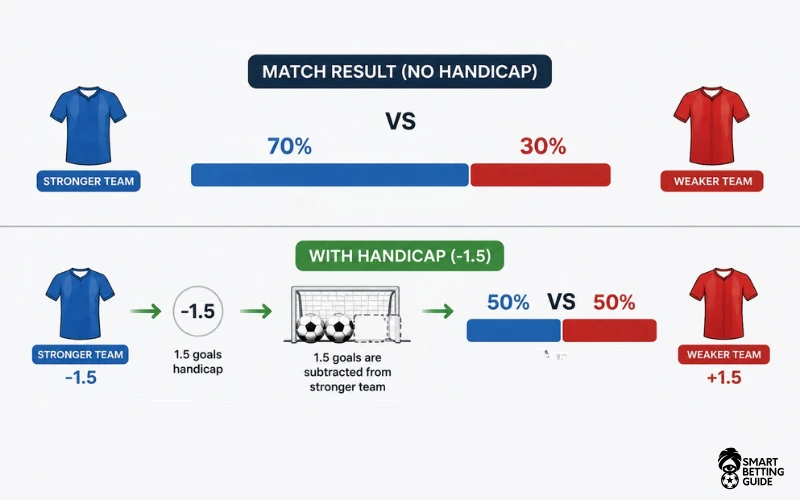
The Asian Handicap market aims to make the contest equal by optimising odds for both teams towards a roughly 50% chance of winning – a structural feature that naturally compresses bookmaker margins compared to traditional win/draw/lose markets.
Types of Handicap in Football Betting
There are two main formats you will come across in football handicap betting: European handicap and Asian handicap. They share the same basic principle but work in meaningfully different ways. Knowing which you are using before you place your bet is essential.
European (Traditional) Handicap
The European handicap, sometimes called the three-way handicap, is the more familiar format for most bettors. European handicaps are three-way markets, meaning you have three choices to bet on. You can back the home team, the away team, or the draw – but the handicap is applied to the score before settlement.
For example, if you back Team A with a -1 European handicap, they need to win by at least two goals. If they win by exactly one, the bet settles as a draw after the handicap is applied – meaning you lose if you backed them to win, but you could have backed the handicap draw instead.
The European handicap presents a straightforward win, draw, or lose scenario after the handicap is applied. It functions much like a standard 1X2 market, but with the handicap included in the final score.
One important thing to remember: in European handicap, there are no refunds. You either win or lose. If the handicap-adjusted score produces a draw and you backed a win, your stake is gone.
Asian Handicap
Asian handicap is somewhat more complex, but it tends to reward bettors who take the time to understand it. The key difference is that the draw is removed entirely as an outcome.
Asian handicap is a way of betting that originates in Asia and mostly used in football. Handicap means that one team has a virtual lead over the other side. Asian handicaps eliminate the chance of a draw in a match, so the possible outcomes are two.
There are several types of Asian handicap line:
- Whole goal (-1, -2, +1) – If the handicap-adjusted score is exactly level, the bet is voided and your stake is returned.
- Half goal (-1.5, +0.5) – A draw after the handicap is impossible, so you always get a definitive result.
- Quarter goal (-0.25, +0.75) – Your stake is split between the two nearest half-goal lines.
A quarter handicap splits your stake into two separate bets, usually on the two closest half-goal handicaps. This allows for partial wins or losses, or a partial refund, depending on the exact match outcome.
So if you back a team with a -0.25 handicap, half your stake goes on the 0 line (Draw No Bet) and half on -0.5. A win gives you a full return; a draw means half your stake is refunded and the other half is lost.
Other Variations
Beyond the standard full-match markets, you may also come across:
- First half / second half handicaps – The handicap applies only to goals scored in the specified half.
- Season-long or league handicaps – Used in outright markets where teams are given a points head start based on expected performance.
These are less common but can offer interesting angles, particularly in cup competitions or early-season matches where one side’s form is genuinely hard to read.
How Football Handicap Betting Works: Step-by-Step
The mechanics are fairly straightforward once you have seen a few examples. The core process is the same regardless of which type of handicap you are using – apply the handicap to the final score, then judge the result.
Let’s say Arsenal are playing Burnley and Arsenal are given a -1.5 Asian handicap in football betting.
- You back Arsenal -1.5 at odds of 1.85
- Arsenal win the match 2-0
- Apply the handicap: 2 minus 1.5 = 0.5 goals to Arsenal
- Arsenal still lead after the adjustment, so the bet wins
If Arsenal had only won 1-0, the handicap-adjusted score would be -0.5 to Arsenal, meaning they effectively lose. The bet would be settled as a loss.
For the football underdog side, the logic is reversed. A bet on Burnley +1.5 wins as long as Burnley do not lose by two or more goals.
Handicap in Football Betting Examples
The table below shows how different scorelines settle under a common football handicap market.
In this example, Team A carries a -1 Asian handicap.
| Final Score (A vs B) | Handicap-Adjusted | Bet on A (-1) | Bet on B (+1) |
|---|---|---|---|
| A wins 2-0 | A leads by 1 | Win | Lose |
| A wins 1-0 | Level (0-0) | Push (refund) | Push (refund) |
| Draw 1-1 | B leads by 1 | Lose | Win |
| B wins 1-0 | B leads by 2 | Lose | Win |
For comparison, under a European -1 handicap, a 1-0 win for Team A would settle as a draw – meaning a bet on A to win would lose, not be refunded. That difference matters enormously in practice.
Pros and Cons of Football Handicap Betting
To explain handicap in football betting, the markets offer some genuine advantages, but they are not without their complications. It is worth being clear-eyed about both sides before diving in.
- Better odds on the favourite than you would find in the standard match result market.
- The Asian handicap specifically offers a lower bookmaker margin in most cases.
- More betting options in matches where the 1X2 market offers little value.
- The possibility of a stake refund (push) with whole-number Asian handicaps provides a degree of protection.
- The difference between European and Asian handicap settlement can catch people out.
- Quarter-goal handicaps require a slightly more careful calculation to understand what you are actually backing.
- A strong favourite can still fail to cover the handicap even while winning comfortably – and a late goal for the other side can flip a settled bet.
Handicap in Football Betting Strategies and Tips
There is no single approach that works in every situation, but there are a few principles that appear to help bettors get more from handicap markets over time.
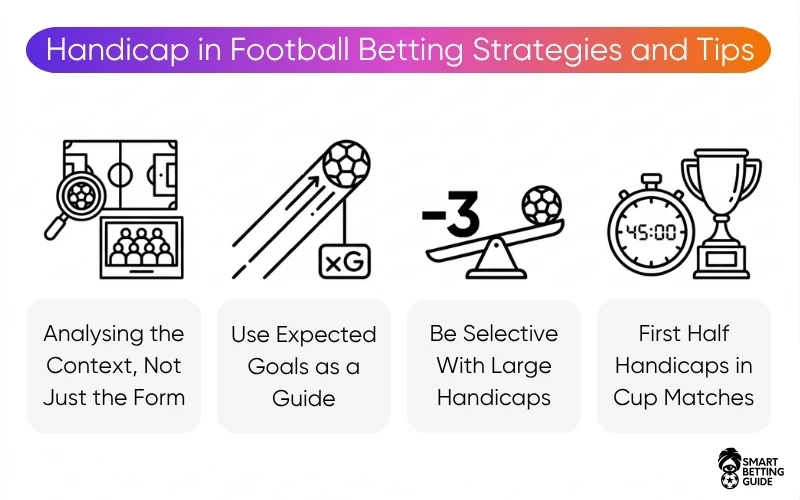
Analysing the Context, Not Just the Form
Team form matters, but context matters more. A team resting key players ahead of a European fixture might still win a domestic match – but they are unlikely to cover a -2 handicap. Similarly, a heavy underdog in a local derby may be far more competitive than their league position suggests.
Before placing a handicap bet, it is worth considering:
- Whether the favourite has strong motivation to win by a large margin.
- The injury and suspension situation for both sides.
- Whether one team is defensively solid, even in defeat.
Use Expected Goals as a Guide
Expected goals (xG) statistics have become widely available in recent years. They give a picture of how many goals each side should have scored based on their chances, rather than just the actual result.
Following expected goals statistics can be extremely helpful when betting on handicaps in football. A team that consistently wins matches 1-0 but generates xG of 2.5 may well be a good candidate for a handicap bet when the market hasn’t adjusted for their underlying performance.
Be Selective With Large Handicaps
Backing a team to win by three or four goals requires a lot to go right. In our experience, large handicap lines – say -3 or more – tend to carry considerably more variance than they appear to on paper.
A conservative team leading 2-0 will frequently ease off, and that can turn a winning handicap bet into a loss with ten minutes to play.
First Half Handicaps in Cup Matches
One market worth considering is the first half handicap in one-sided cup ties. Stronger sides tend to take early control, and an underdog that sits deep may concede quickly before settling into their defensive shape.
A -1 first half handicap on a heavy favourite can occasionally offer better value than the full match equivalent.
Football Handicapping at the FIFA World Cup
The FIFA World Cup is one of the few tournaments where handicap in football betting can look very different from regular league play – mainly because of the mismatch factor.
In the group stage, you’ll often see top nations facing teams with far less experience at this level. That’s why handicap lines can be much higher than usual. Instead of the typical -1 or -1.5 you see in domestic leagues, it’s common to find lines like -2.5 or even -3 when there’s a clear gap in quality.
To make this more practical, think in terms of real matchups:
- France national football team vs Australia national football team (2018 World Cup) → France were clear favourites, but only won 2–1. A -2 handicap would have lost.
- Spain national football team vs Costa Rica national football team (2022 World Cup) → Spain won 7–0. Here, even a -3 handicap was easily covered.
- Germany national football team vs Japan national football team (2022 World Cup) → Germany were heavy favourites but lost 1–2. Any handicap bet on them failed completely.
In practice, many bettors prefer Asian handicap markets in the World Cup. The reason is simple – they offer more protection. If you take a -2 line and your team wins by exactly two goals, you get your stake back.

18+ Only. Play Responsibly.
Gambling can be addictive. Play for entertainment, never chase losses or risk your well-being. If gambling is affecting your life, confidential help is available.



FAQ About Handicap in Football Betting
⭐ What does handicap in football betting mean?
Handicap in football means a virtual goal advantage or disadvantage is applied to one team before the bet is settled. The result is judged after that adjustment, not on the actual final score alone.
⭐ What is the difference between Asian and European handicap?
The main difference is the draw. European handicap is a three-way market that includes the draw. Asian handicap removes the draw entirely – if the handicap-adjusted score is level on a whole-number line, your stake is refunded.
⭐ Can you lose a handicap bet even if your team wins?
Yes. If you back a team with a -2 handicap and they win by only one goal, the handicap-adjusted result favours the other side and your bet loses.
⭐ What is a push in Asian handicap betting?
A push happens when the handicap-adjusted score is exactly level on a whole-number Asian handicap. In that case, your stake is returned in full – you neither win nor lose.
⭐ Is Asian handicap better than European handicap?
It depends on your preference and the specific market. Asian handicap generally offers a lower bookmaker margin, which suggests it provides better long-term value. However, European handicap is simpler to understand and some bettors prefer the three-way structure it offers.

Crypto and Sports Betting Expert