Differences in Football Betting Across Countries
-
 Written by
Dalius Mikalauskas
Written by
Dalius Mikalauskas -
05 Aug 20265 min. read

Football betting is a global industry worth around $200 billion every year. But placing a bet on the same match can feel completely different depending on where you live. The odds format, the tax on your winnings, the payment methods available, and which leagues you can bet on – all of these depend on your country.
Whether you bet for fun or take it seriously, knowing how football betting works around the world can help you make smarter decisions and identify potential value.
Table of content
- Key Takeaways
- Why Football Betting Is Different Around the World
- Football Betting in Europe
- Football Betting in Asia
- Football Betting in the Americas
- Tax on Football Betting Winnings by Country
- How Culture Shapes Betting Behaviour
- How Regulations Affect the Market
- Common Mistakes When Betting Across Countries
Key Takeaways
- Betting rules, taxes, and markets are different in every country
- The UK, Spain, Italy, China, and the US have the biggest betting markets
- Asian handicap is the most popular market among professional bettors
- Some countries tax your winnings heavily. Others charge nothing at all
- E-wallets dominate in Asia. PIX is the top payment method in Brazil
Why Football Betting Is Different Around the World
The rules bettors follow depend almost entirely on where they live. Local gambling laws, cultural attitudes, and the number of licensed bookmakers all shape the betting experience.
In countries with strong regulations, bettors get better consumer protections and more competitive odds.
In countries where betting is restricted, many people use offshore platforms – which comes with its own risks. A bettor in London, one in Bangkok, and one in São Paulo can all be watching the same Champions League game and have a completely different betting experience.
Football Betting in Europe
Europe is the home of modern football betting. Countries like the UK, Spain, Italy, and Germany have large, well-regulated betting industries.
In the United Kingdom and Italy betting winnings are completely tax-free for bettors. Operators pay the tax instead, which pushes bookmakers to compete hard on odds and promotions.
Germany works differently – bettors pay a 5% tax on every stake they place, not just on winnings. This quietly eats into profits before you even start.
European bettors usually study stats before placing bets. Match winner, Asian handicap, and over/under goals are the most popular markets. Live betting – where odds change during the game – is also widely available.
Most popular leagues: Premier League, La Liga, Bundesliga, Serie A, Ligue 1, Champions League.
Football Betting in Asia
Asia has a massive appetite for football betting, but many countries have strict laws against it. China bans most private betting, yet billions of dollars still flow through offshore and illegal operators every year.
Asia gave the world the Asian handicap – a betting format that removes the draw option by giving one team a head start. It creates fairer odds and smaller bookmaker margins, which is why professional bettors prefer it worldwide.
Tax rules differ a lot across the region. Japan taxes gambling winnings as income, with rates up to 55% for high earners. The Philippines charges a flat 20% on winnings.
Most used payment methods: Local e-wallets, cryptocurrency (especially USDT on offshore sites).
Most popular leagues: Premier League, J-League, K-League, Chinese Super League.
Football Betting in the Americas
In 2018, the US Supreme Court gave individual states the power to legalise sports betting. By 2024, over 35 states had done so. Total US sports betting handle passed $100 billion in 2023. American bettors focus mainly on the World Cup and Champions League for soccer. All gambling winnings in the US are taxed as regular income – up to 37%.
In South America, Brazil legalised sports betting in 2023, turning one of the world’s biggest grey markets into a regulated one. South American bettors are loyal to their local clubs, which often leads them to bet emotionally rather than analytically. This creates opportunities for more informed bettors to find value.
Most used payment methods: PIX (Brazil), Mercado Pago, PayPal and ACH (USA), cryptocurrency.
Most popular leagues: Série A, Primera División, Copa Libertadores, MLS, Champions League.
Tax on Football Betting Winnings by Country
🇬🇧 United Kingdom 0% for bettors (paid by operator) → Full winnings kept; only slightly lower odds
🇦🇺 Australia 0% for bettors (paid by operator) → Same as UK, no direct tax on profits
🇮🇹 Italy 0% for sports betting with licensed operators → Only lottery-style winnings are taxed (~12%), so most bettors keep full profits
🇪🇸 Spain 19–47% income tax on net winnings → Only profits are taxed, so bettors pay tax only on real gains, but overall returns are still reduced
🇩🇪 Germany 5.3% tax on every stake → Reduces effective bet size, long-term profit drops
🇺🇸 United States Up to 37% income tax on winnings → Major profit loss, taxes apply to winnings, not just net profit
🇵🇭 Philippines 20% flat tax on winnings → Significant direct cut from every win
🇯🇵 Japan Up to 55% income tax → Very high tax, heavily reduces long-term profitability
How Culture Shapes Betting Behaviour
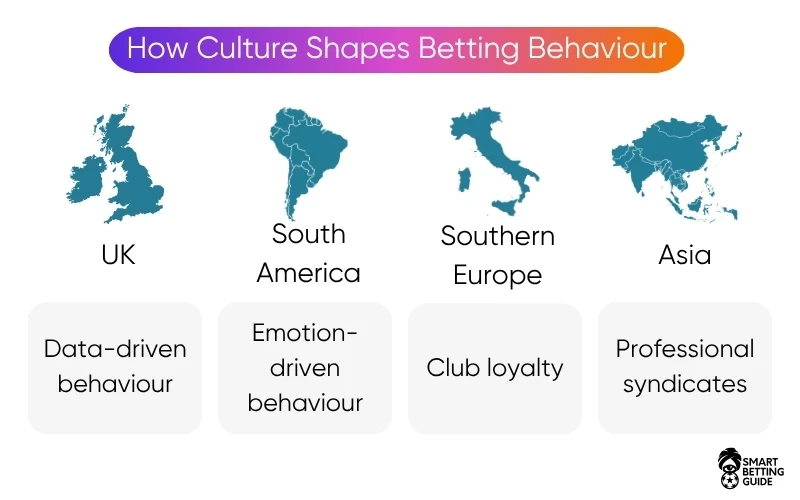
Where you grow up changes how you bet. UK bettors tend to be analytical, using stats, models, and betting exchanges to find value.
In South America and Southern Europe, bettors often follow their hearts – backing their favourite clubs even when the odds are against them.
In Asia, professional betting syndicates treat betting like a financial operation. Their activity is often what causes big odds movements on major bookmakers. Knowing whether a market is driven by emotional fans or sharp professional money is one of the most useful things a bettor can understand.
How Regulations Affect the Market
Regulation is the biggest factor shaping any betting market. In well-regulated countries like the UK and Australia, bookmakers must keep customer funds separate, offer responsible gambling tools, and follow strict advertising rules.
In less regulated markets, odds can be higher but bettors have little protection if something goes wrong. Licences from Malta (MGA), Gibraltar, and the Isle of Man offer a middle ground – some oversight without the full requirements of a domestic licence.
Common Mistakes When Betting Across Countries
One of the most common mistakes is assuming all markets work the same way. Odds formats are different everywhere – decimal in Europe, fractional in the UK, and moneyline in the US. Getting these mixed up can be costly.
Ignoring local tax rules is another big error. Using an offshore platform does not automatically make your winnings tax-free in your home country. In the US, Germany, and Australia, you are still expected to declare gambling income.
Betting on leagues you do not know well is also risky. Bookmakers have expert traders covering even smaller competitions. The knowledge gap usually favours the house.
FAQ About Football Betting Around the World
⭐ Why do betting markets differ between countries?
Local laws, culture, and the number of licensed bookmakers all play a role.
⭐ Are odds the same worldwide?
No. Odds vary between bookmakers and regions depending on betting volume and local demand.
⭐ Do I pay tax on winnings?
It depends on your country. The UK charges nothing. The US taxes winnings as income. Germany taxes every stake at 5%.
⭐ Is football betting legal everywhere?
No. Some countries fully regulate it, others restrict it, and some ban it completely.
⭐ Are international bookmakers safe to use?
Yes, if they hold a licence from a recognised regulator like the UKGC or MGA.

Crypto and Sports Betting Expert