
Show more
Show less
How to Understand Betting Odds in Sports?
-
 Written by
Dalius Mikalauskas
Written by
Dalius Mikalauskas -
29 Jul 20265 min. read

Betting odds play a central role in sports betting as they reflect perceived probability, determine your potential payment and protect bookmakers from risk. Yet many bettors still misunderstand what odds truly do and how betting odds work, often treating them as predictions or guarantees rather than what they really are – prices shaped by data, market behavior and psychology. .
Understanding how betting odds are made and how they work in real sports like football and basketball is one of the most important steps toward smarter betting. Odds are not designed to help bettors win. They are designed to balance markets and ensure long-term profitability for bookmakers.
Table of content
Table of content
- Key Takeaways
- What Do Betting Odds Mean in Sports Betting?
- Types of Betting Odds Explained
- How are Betting Odds Calculated by Bookmakers
- Why Betting Odds Are Designed to Shape Bettor Behavior?
- How Public Betting Bias Affects Odds in Football and Basketball
- Why Betting Odds Change Before a Match
- Why Closing Odds Matter More Than Predictions
- How Bookmakers Make Money in the Long Run
- Summary of Betting Odds
Key Takeaways
- Betting odds reflect probability and market behavior, not a prediction
- Bookmakers use data models, human judgment, and margins
- Public money often negatively affects odds on popular teams
- Odds change due to money flow, news, and sharp bettors
- Those who beat the closing line are profitable long-term
What Do Betting Odds Mean in Sports Betting?
At their core, betting odds represent implied probability – the likelihood a bookmaker assigns to a specific outcome.
Decimal odds of 2.00 imply a 50% chance
Odds of 4.00 imply a 25% chance
Odds of 1.50 imply roughly a 66.7% chance
In football betting, a Champions League favorite priced at 1.40 may look “safe,” but that price already assumes dominance. In basketball betting, an NBA home favorite at 1.30 often reflects public confidence more than true edge.
Importantly, odds always include a bookmaker margin (overround). This margin ensures the bookmaker profits over time, even when outcomes vary.
Types of Betting Odds Explained
All odds formats represent the same probability, they are just displayed differently.
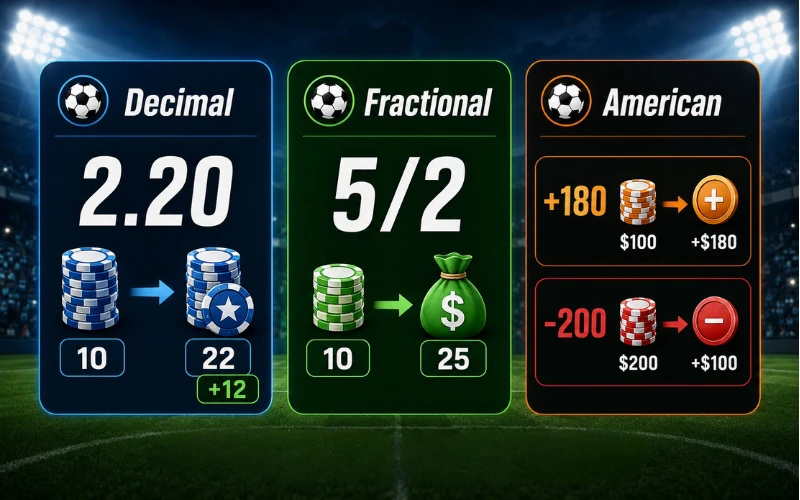
Decimal Odds (European Format)
Decimal odds show your total return, including stake.
Football example:
Odds: 2.20
Stake: €10
Return: €22 (€12 profit)
Fractional Odds (UK Format)
Fractional odds show profit relative to stake.
Football example:
Odds: 5/2
Stake: £10
Profit: £25
American Odds (US Format)
American odds are common in American bookmakers or in NBA and NFL betting.
Example:
+180 betting odds means you win $180 on a $100 bet
-200 betting odds means you must stake $200 to win $100
How are Betting Odds Calculated by Bookmakers
Reputable online bookmakers calculate betting odds by combining data, probability, market demand, and built-in margin. The goal is not only to predict the outcome, but also to create prices that manage risk and protect long-term profit.
Statistical Models and Historical Data
Odds creation begins with advanced algorithms that analyze team and player statistics, recent form, head-to-head records, injuries, suspensions, scheduling, and travel.
Basketball example:
NBA back-to-back games strongly influence odds. A team playing its second game in two nights, especially after travel, may see its odds worsen before any official lineup announcement.
Football example:
In international tournaments, odds often move based on group standings, qualification scenarios, and motivation rather than squad strength alone.
Human Traders and Situational Context
Models cannot fully measure motivation, psychology, or tactical intent. Human traders adjust odds based on context.
A football team fighting relegation may outperform expectations. A basketball team already locked into playoff seeding may rest starters. Markets often react to expectations before confirmation.
The Bookmaker Margin Explained
After estimating the true probability of an outcome, bookmakers add a small margin to the odds. This is why “fair” odds don’t really exist in practice.
Their real advantage isn’t about predicting results better than everyone else – it’s about building that margin into every price. Casual bettors always pay this built-in cost, while in more competitive or sharper markets, the margin is simply smaller – but it’s still there.
Why Betting Odds Are Designed to Shape Bettor Behavior?
A common myth is that odds exist purely to predict results. In reality, odds are also a behavioral and psychological tool.
Bookmakers understand how people bet. Casual bettors prefer favorites, fans bet emotionally on big clubs, and many players look for “safe” odds rather than value.
Football example:
When Real Madrid plays a mid-table La Liga team at home, odds like 1.65 often attract huge betting volume. Even if the true probability suggests higher odds, bookmakers shorten the price because they know people will bet anyway.
Basketball example:
In the NBA, teams like the Lakers or Warriors often receive inflated support, especially in nationally televised games. Odds are adjusted to reflect popularity, not just performance.
Odds do not just reflect reality – they guide where money flows.
How Public Betting Bias Affects Odds in Football and Basketball
Public opinion often moves odds more than data.
Football bias includes overbetting big clubs, national teams, and home sides. During major tournaments, host nations frequently receive shorter odds than justified by performance alone.
Basketball bias focuses on star players, popular franchises, and televised games. Well-known teams often offer worse value because demand inflates prices.
The most popular teams are frequently the worst value bets, not because they are weak, but because everyone wants to bet on them.
Why Betting Odds Change Before a Match
Odds constantly adjust to manage risk.
Heavy betting volume on one outcome forces bookmakers to shorten odds and rebalance exposure. Sharp money from professional bettors can move lines quickly, especially in early markets. News such as players injuries, rotation plans, or weather conditions can also trigger sudden changes.
Bookmakers fear information more than bettors. Limits exist because early or exclusive information creates risk.
Why Closing Odds Matter More Than Predictions
Opening odds reflect models and early opinion. Closing odds reflect everything the market knows.
By kickoff or tip-off, odds include public and sharp money, injury updates, confirmed lineups, and tactical expectations. For this reason, many professionals measure success by beating the closing line rather than short-term profit.
A bettor can lose money while making good bets and win money while making bad ones. Odds only reveal their truth over time.
How Bookmakers Make Money in the Long Run
Bookmakers aim to balance markets so money is spread across outcomes. When this happens, the margin guarantees profit regardless of the result.
This is why emotional betting, chasing favorites, or betting popular teams usually benefits the bookmaker, not the bettor. Only those who beat the closing line constantly and find the value are profitable for long-term in sports betting.
Summary of Betting Odds
Betting odds should be understood as prices, not predictions. They show how bookmakers value an outcome, but they do not guarantee what will happen. A bet can have value and still lose, while a poor bet can win in the short term.
Popular teams and low odds are not always profitable choices, because public demand is often already included in the price. One result proves very little. In the long run, disciplined betting, value selection, and consistency matter far more than short-term luck.
FAQ About Betting Odds
⭐ Are low odds safer in betting?
No. Low odds often reflect public confidence rather than true betting value.
⭐ Why do some betting odds move so quickly?
Because lineup news, player rest, injuries, and sharp money strongly affect betting markets.
⭐ Can understanding odds help me beat bookmakers?
It helps identify value bets, but discipline and bankroll management remain essential.
⭐ Are odds the same across bookmakers?
No. Different bookmaker margins, risk tolerance, and customer profiles lead to different odds pricing.
⭐ Do odds guarantee long-term profit?
No. Odds create betting opportunities, but strategy and execution determine long-term results.
⭐ How do odds works?
Odds show the chance of an outcome and how much you can win. Lower odds mean a result is more likely but pays less; higher odds mean it is less likely but pays more.

Dalius Mikalauskas
Crypto and Sports Betting Expert
Dalius Mikalauskas is a crypto and sports betting expert and Project Manager at SmartBettingGuide, with over 20 years of experience. He specializes in basketball, football, tennis, and other online sports betting markets. Dalius also has a long history as a professional poker player, spending thousands of hours playing live poker in cities like L ..
Latest Articles


Get expert tips, news, and insights on betting delivered straight to your inbox.

