The FIFA World Cup 2026 will be the biggest tournament in football history. But the changes go beyond just adding more teams – the structure, qualification system and even match rules have all been adjusted in ways that will directly affect how the competition plays out.
On paper, it’s just a bigger tournament. In practice, it will feel very different.
Table of content
Key Takeaways
- The tournament expands to 48 teams.
- 12 groups of 4 teams maintain a familiar structure.
- 32 teams advance to the knockout stage.
- A total of 104 matches will be played.
- The tournament runs from June 11 to July 19, 2026.
- Hosted by the USA, Canada and Mexico across 16 cities.
FIFA World Cup 2026 Expands To 48 Teams
The most obvious change is the expansion from 32 to 48 national teams. That opens the door for more countries to qualify, particularly from Africa, Asia and North America.
It also brings a wider mix of playing styles into the tournament, which makes the group stage less predictable than before. For established teams, preparation becomes less straightforward.
Facing unfamiliar opponents at the World Cup early on adds a different layer to the tournament compared to previous editions.
Three Host Nations And 16 Cities
For the first time, the tournament will be hosted by three countries:
- United States
- Canada
- Mexico
FIFA has confirmed matches will take place across 16 host cities – 11 in the USA, 3 in Mexico and 2 in Canada. With venues spread across a large area, travel becomes part of the challenge.
Teams will need to handle longer distances between games, which can influence recovery and preparation.
FIFA World Cup 2026 Qualification Changes
FIFA has officially confirmed the qualification slot allocation:
- UEFA (Europe) – 16 places
- CAF (Africa) – 9
- AFC (Asia) – 8
- CONMEBOL (South America) – 6
- CONCACAF – 6 (including the 3 host nations)
- OFC (Oceania) – 1 direct place
- 2 additional places via intercontinental playoffs
Oceania now has a guaranteed spot for the first time, while the intercontinental playoff adds another route for teams that fall just short in their regions.
New Rules Introduced For FIFA World Cup 2026
FIFA is not only changing the structure of the tournament, but considering and testing several rule adjustments aimed at improving game flow and reducing time-wasting.
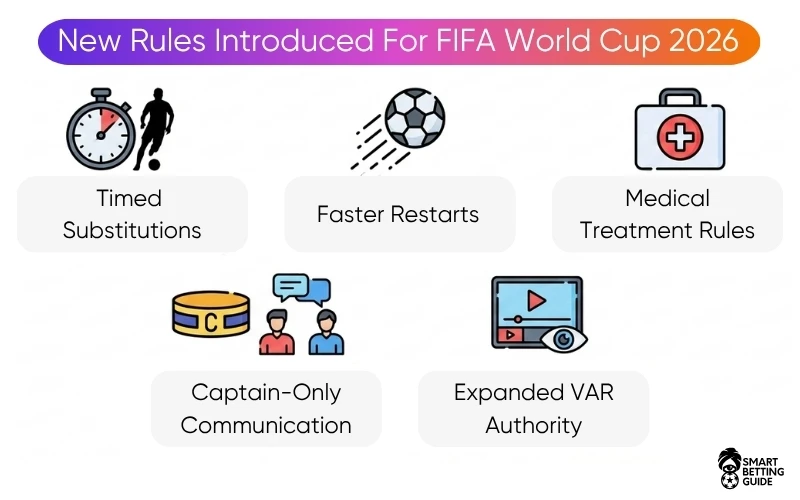
Timed Substitutions
Players leaving the field will now have just 10 seconds to do so. If they take longer, the incoming player must wait one full minute before entering, leaving their team temporarily with one fewer player.
That kind of risk should naturally discourage players from slowing the game down during substitutions.
Faster Restarts
Goal kicks and throw-ins will have a five-second limit. If the ball is not put back into play in time, possession is awarded to the opponent.
If the time limit is exceeded, possession will be handed to the opponent. That should naturally increase the tempo of matches and remove unnecessary delays.
Medical Treatment Rules
Players who receive treatment on the pitch must leave the field and remain off for at least one minute before returning, unless the injury resulted from a foul that led to a card.
That should limit unnecessary stoppages during games.
Captain-Only Communication
Only the team captain will be allowed to approach the referee. Other players risk an immediate yellow card if they interfere.
The goal is to reduce pressure on officials and avoid crowding around referees.
VAR will now be able to review second yellow cards that lead to a sending-off, as well as incorrectly awarded corner kicks.
This gives referees more support in key moments where decisions can change the outcome of a match.
What FIFA World Cup 2026 Will Be Like
The FIFA World Cup 2026 is not just an expanded version of the previous format. More teams bring more variety, but also more unpredictability.
With a larger field and more matches, maintaining consistency becomes more difficult, even for the strongest teams.
At the same time, the rule changes are likely to speed up the game and reduce interruptions, which could lead to a more consistent tempo across matches. Travel, recovery and in-game decision-making will all play a bigger role than before.
In a tournament of this scale, small details will matter more than ever. Licensed bookmakers will need to adapt to these changes to offer more accurate odds and better betting opportunities.
FAQ About FIFA World Cup Changes
⭐ How many teams will play in the FIFA World Cup 2026?
The tournament will feature 48 national teams, making it the largest World Cup in history.
⭐ What is the format of the FIFA World Cup 2026?
There will be 12 groups of 4 teams. The top two teams from each group and the 8 best third-placed teams will advance to the knockout stage.
⭐ Is there a new knockout round?
Yes, a Round of 32 has been added, meaning teams need to win one additional knockout match to reach the final.
⭐ How many matches will be played?
A total of 104 matches will be played during the tournament.
⭐ When will the tournament take place?
The FIFA World Cup 2026 will run from June 11 to July 19, 2026.
⭐ Which countries are hosting?
The tournament will be hosted by the United States, Canada and Mexico.
⭐ What are the biggest rule changes?
Key updates include timed substitutions, faster restarts, stricter medical rules, captain-only communication with referees and expanded VAR authority.

Crypto and Sports Betting Expert