Blockchain for Sports Betting
-
 Written by
Iyke Aru
Written by
Iyke Aru -
27 Jul 20268 min. read

Sports betting handles hundreds of billions in bets every year, yet trust issues, slow payouts, and a lack of transparency keep coming up. Blockchain for sports betting is changing that.
In this guide, we break down exactly how blockchain for sports betting works, what it means for you as a bettor, and where the industry is heading.
Table of content
- Key Takeaways
- What Is Blockchain Technology?
- How Blockchain Is Used in Sports Betting?
- Main Benefits of Blockchain for Sports Betting
- Risks & Limitations to Know About Blockchain Sports Betting
- Regulation & Legal Landscape of Blockchain Betting
- The Future of Blockchain for Sports Betting
- Our Final Thoughts on Blockchain in the Sports Industry
Key Takeaways
- Blockchain records every bet and payout in a way that can’t be changed later
- Smart contracts automate payouts without human involvement
- Crypto deposits and withdrawals are faster and cheaper than traditional banking
- Provably fair betting lets you verify outcomes yourself
- Regulatory frameworks are still developing, but progress is moving quickly
- There are risks, like volatility, irreversible payments, and smart contract bugs
What Is Blockchain Technology?
A blockchain is a shared database that isn’t controlled by a single company or stored in a single place. Instead, it’s copied across thousands of computers worldwide. When a new transaction occurs, every copy updates at the same time.
What makes it different is that once something is recorded, it can’t be changed or deleted. No one — not a sports betting site, a government, or a hacker — can go back and edit it.
For gambling, this is a big deal. Traditional bookmakers work like closed systems: you place a bet and trust they settle it fairly. With the sport betting blockchain, every bet and result can be checked publicly, so you don’t have to just trust the platform.
How Blockchain Is Used in Sports Betting?
When exploring blockchain and sports, you’ll notice this technology in a few parts of the betting experience.
From what we’ve seen, it makes the biggest difference in three main areas: smart contracts and automated payouts, provably fair betting, and cryptocurrency deposits and withdrawals.
Smart Contracts & Automated Payouts
A smart contract is code that runs on a sports betting blockchain and executes automatically. Think of it like a vending machine — you meet the conditions, and the result happens instantly. No middlemen and no waiting for someone to approve your payout.
In sports betting, smart contracts work like this:
- You place a bet, and your funds are locked in the contract
- An oracle (trusted data source) confirms the result
- The contract processes it and sends the correct payout to your wallet
The whole process can take just seconds or a few minutes.
The main benefit is that the blockchain sports betting site can’t interfere. Once the contract is live, it runs exactly as written. This removes common issues like delays or withdrawal holds.
For example, if you with blockchain bet on a Champions League match, the result is confirmed, and your winnings are sent to your wallet almost instantly. No reviews, no waiting, no support tickets.
Provably Fair Betting
“Provably fair” might sound like marketing, but it has a clear technical meaning. It uses cryptography, so you can verify for yourself that a result wasn’t changed before, during, or after the bet.
Here’s how it compares to a traditional online sports betting site:
| Feature | Traditional Bookmaker | Blockchain Bookmaker |
|---|---|---|
| Outcome verification | Not possible | Fully verifiable |
| Odds manipulation risk | Present | Near-zero |
| Settlement audit | Internal only | Public on-chain record |
| Dispute resolution | Operator decides | Code-enforced |
On provably fair sports betting platforms, the random seed that determines outcomes is created and stored before the event. Afterward, you can verify it using public tools.
If everything matches, the result is fair. If not, you have clear proof. In simple terms, it puts control in your hands instead of the operator’s.
Cryptocurrency Deposits & Withdrawals
Most blockchain sports betting sites accept Bitcoin, Ethereum, USDT, and other stablecoins. The biggest benefit for bettors doing sports betting on blockchain platforms is speed.
Traditional sports betting sites can take 1 to 5 business days to process withdrawals to a bank or card. With crypto, depending on the network, funds usually arrive in minutes.
Below, you’ll see a quick comparison table that our team created:
| Method | Withdrawal Time | Fees | Chargeback Risk |
|---|---|---|---|
| Bank transfer | 1–5 days | Medium–High | Possible |
| Credit/debit card | 1–3 days | Medium | Yes |
| Bitcoin | 10–60 minutes | Low | No |
| USDT (TRC-20) | Under 5 minutes | Very low | No |
| Lightning Network BTC | Seconds | Near-zero | No |
There’s also the privacy factor. Many crypto bookmakers offer no-KYC options, so you don’t need to upload documents like a passport or utility bill to get started. This can be useful in regions where access to certain platforms is limited.
Main Benefits of Blockchain for Sports Betting
When you look at what blockchain for sports betting actually offers, a few benefits stand out. These benefits genuinely improve how betting works day to day, not just in theory.
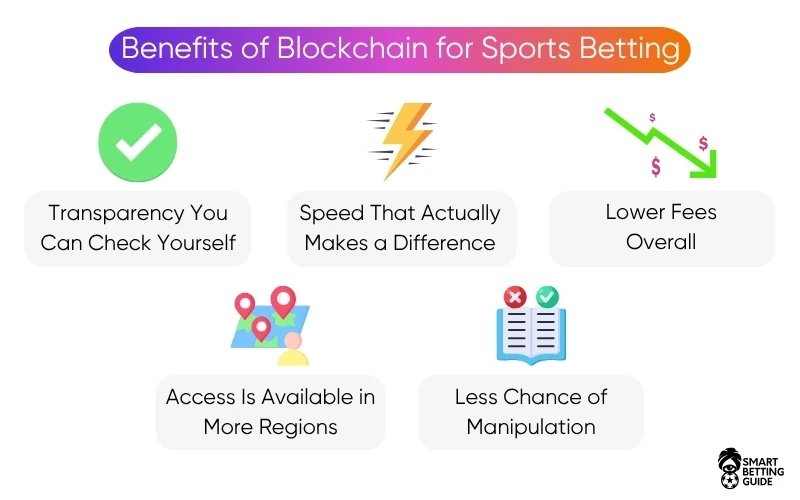
Transparency You Can Check Yourself
Every blockchain sports bet, payout, and even odds change is recorded publicly. That means you don’t have to rely on the sports betting platform’s internal data or just trust that everything is correct — you can verify it yourself at any time.
Speed That Actually Makes a Difference
Getting paid faster changes the whole betting experience. Instead of waiting days for a bank transfer, crypto withdrawals usually arrive within minutes, sometimes even seconds, depending on the network.
This changes how quickly you can reuse your funds or move between several bookmakers.
Lower Fees Overall
Traditional payment methods involve multiple intermediaries, each adding costs. These often show up as higher fees or less favorable conditions for bettors.
Crypto networks — especially newer, faster ones — reduce these costs significantly.
Access Is Available in More Regions
In many countries, banking restrictions limit access to international online betting sites.
Crypto removes that dependency, allowing bettors from different parts of the world to deposit and withdraw without relying on local banks. This is one of the clearest examples of how sports and blockchain are reshaping access to global markets.
Less Chance of Manipulation
Smart contracts follow fixed rules and execute automatically. There’s no manual approval process — once the outcome is confirmed, the payout is processed exactly as intended with no way to change it.
Risks & Limitations to Know About Blockchain Sports Betting
Blockchain betting also has its downsides. We think it’s important to be upfront about these, so you understand them before you start, and can make an informed decision.
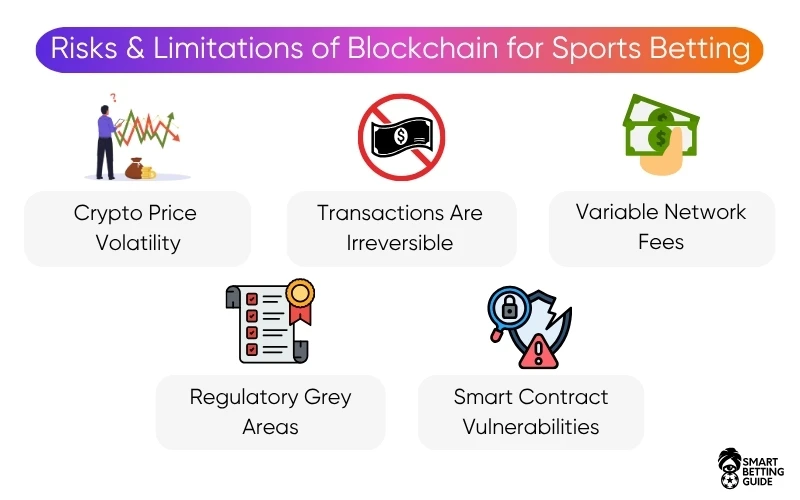
Crypto Price Volatility
If you deposit Bitcoin and the price drops before you withdraw, your balance can lose value even if your bets win. Stablecoins like USDT or USDC avoid this, but you need to choose them wisely.
Transactions Are Irreversible
If you send funds to the wrong address, there’s no way to get them back. There’s no bank or support team that can fix it, so you always need to be careful when sending crypto.
Variable Network Fees
In blockchain betting, fees aren’t always the same. On networks like Ethereum, they can go up a lot when the network is busy. A cheap transfer today could cost much more later.
Regulatory Grey Areas
Depending on where you live, blockchain in sports betting might not be clearly regulated. It doesn’t always mean it’s illegal, but you might not have the same protection as with licensed local bookmakers.
Smart Contract Vulnerabilities
Smart contract risk problems are rare, but they can happen. If a smart contract has a bug, it can be exploited in unintended ways. Good sports betting sites online check their code, but no system is completely risk-free.
Regulation & Legal Landscape of Blockchain Betting
The rules around crypto betting are constantly changing, so we will focus on where things stand now in the blockchain sports betting field.
In the United States, there’s no federal law that directly bans individual players from using an offshore crypto bookmaker.
The main law, the UIGEA, focuses on financial institutions, not bettors. That said, rules can vary widely by state, and as we mentioned, the situation is still changing every day.
In Europe, crypto betting sites are becoming more accepted. Regulators like the Malta Gaming Authority (MGA) and Curaçao eGaming already license sites that accept crypto.
More sports betting operators are also applying for licenses in newer regulated markets, especially in Latin America and Southeast Asia.
Here are a few trends going into 2026:
- More countries are creating new rules for crypto gambling
- EU MiCA rules are bringing greater clarity and affecting the gambling industry
- Prediction markets blur the line between betting and trading
- KYC and AML checks are getting stricter, even on crypto sites
The Future of Blockchain for Sports Betting
Our team noticed several trends related to blockchain for sports betting that are already starting to influence what comes next and will probably have a huge impact over the next few years.
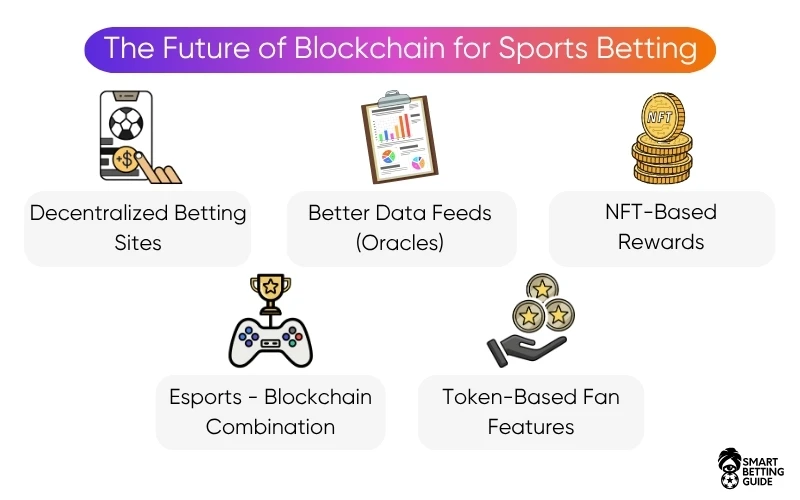
Decentralized Betting Sites
Some bookmakers are stepping away from the usual “one company in charge” setup. Instead, users get a say — voting on rules, fees, and even how disputes are handled. It’s still early days, but the idea is starting to catch on.
Better Data Feeds (Oracles)
These systems decide how bets are settled, so speed and accuracy matter. Newer setups are making blockchain for sports data faster and more reliable, especially for live betting, where every second counts.
NFT-Based Rewards
Instead of the usual bonus points, some sports betting sites are trying NFTs. The difference is simple — you can trade or sell them, so your rewards don’t just stay locked on one site.
Esports and Blockchain Combination
This pairing feels natural within the broader blockchain for sports betting aspect. Esports is already digital, easy to track, and attracts players accustomed to online tools and crypto.
Token-Based Fan Features
Clubs and platforms are starting to test sport blockchain tools that give fans a real stake — not just watching, but holding small shares tied to outcomes or revenue. With this trend, the gap between fans and participants is slowly narrowing.
Our Final Thoughts on Blockchain in the Sports Industry
Overall, the relationship between blockchain and sports betting is changing how the whole process works in a meaningful way. It makes the process more transparent, speeds up payouts, and gives you more control over your funds.
At the same time, it’s not risk-free. Price swings, irreversible transactions, and unclear rules in some regions mean it’s important to be careful.
However, sticking to trusted, licensed sports betting platforms and using stablecoins can help reduce some of these risks.
If you’re ready to explore what blockchain sports betting looks like in practice, our platform comparison guide covers the top-rated options available right now.
FAQ About Blockchain for Sports Betting
⭐ What is blockchain sports betting, and how does it work?
It’s betting on sports betting platforms that use blockchain to record bets, run smart contracts, and handle payouts in crypto.
⭐ Is blockchain sports betting legal in my country?
It depends on where you live. In many places, offshore crypto betting platforms aren’t outright banned for bettors, but rules vary.
⭐ What’s the difference between blockchain bookmakers and traditional betting sites?
A sports betting blockchain uses smart contracts, accepts crypto, and records transactions publicly, while traditional betting sites rely on internal systems and banks.
⭐ What does “provably fair” mean in blockchain sports betting?
“Provably fair” in blockchain for sports betting means you can verify yourself that the results weren’t changed, using public blockchain data.
⭐ Are crypto withdrawals faster on blockchain betting platforms?
Yes. Most crypto withdrawals on blockchain betting platforms take minutes, while bank payouts usually take 1–5 business days.
⭐ What are the main risks of blockchain for sports betting?
The main risks of blockchain for sports betting include price volatility, irreversible payments, changing fees, smart contract issues, and unclear regulations.
⭐ Do I need a crypto wallet for blockchain sports betting?
Yes. You need a crypto wallet to deposit and withdraw, such as MetaMask or Trust Wallet.
⭐ What cryptocurrencies do blockchain betting platforms accept?
Bitcoin and Ethereum are the most widely supported. Nonetheless, many platforms also accept USDT, USDC, and other stablecoins, as well as platform-specific tokens.

Crypto Content Writer