
The best anonymous betting sites require fewer initial document checks, but online betting without verification does not guarantee privacy at withdrawal.
We compare all three verification levels (Pure Web3, soft KYC, and standard KYC) and explain registration, withdrawals, licenses, payments, bonuses, and privacy risks to help you weigh convenience against customer protection.
Table of content
- The Best Betting Sites Without Verification Reviews
- How We Choose No-Verification Betting Sites
- What Are Anonymous Betting Sites?
- Types of No-Verification Betting Accounts
- Verification Levels at Anonymous Betting Sites
- How to Sign Up at Betting Sites and Apps Without ID Verification
- How Licensing Affects Betting Without Verification?
- Are Anonymous Betting Sites Without Verification Legal?
- Benefits and Risks of Betting Sites with No Verification
- How Anonymous Betting Sites Can Still Identify You
- How to Choose a Reliable No-Verification Betting Site
- Payment Methods on Betting Sites Without Verification
- Anonymous Betting Through Telegram Bots
- Bonuses and Promotions at No-Verification Betting Sites
- Anonymous Betting Tips
- Do Anonymous Betting Sites Check Your Age?
- Gamble Responsibly on Anonymous Betting Sites
The Best Betting Sites Without Verification Reviews
Below is our current list of the best betting sites without verification, checked, tested, and ranked using the process explained further down this page.
How We Choose No-Verification Betting Sites
We assessed every betting site the same way, from traditional bookmakers to anonymous sports betting sites: real sign-ups and real withdrawal attempts, compared with what each operator’s terms actually promise.
From there, we ranked each site below using five measurable factors, from registration requirements to account controls.
- Registration requirements come first. We log exactly which personal details and documents each operator requests before opening an account, so no claim from the best no verification betting sites relies on marketing alone
- Withdrawal evidence matters most. Real payout tests track the amount, payment method, processing time, and any documents requested along the way, and they carry more weight than an operator’s own payout page
- Licensing starts with the regulator’s public register, where we confirm the operator and website domain match an active entry, not just a badge on the homepage.
- Data handling – what each operator collects, how it’s used, and how long it’s kept
- Account controls matter to us, too. We check betting options, odds, and live-betting coverage, along with spending limits, self-exclusion tools, and complaint procedures
What Are Anonymous Betting Sites?
A betting site with no ID check lets you register, and often deposit, without uploading identity documents upfront. Anonymous betting sites promise the same: less personal information at sign-up, though neither label guarantees full anonymity.

Most sites that skip documents at sign-up still request them later, typically before a withdrawal, once you understand KYC: “Know Your Customer,” the checks operators use to confirm who you are. A passport supports those checks; an email only proves access to an inbox. A passport supports those checks, while an email only provides access to an inbox.
A KYC betting site can run checks electronically, comparing your details against databases instead of requiring an upload. A document-free sign-up therefore doesn’t always mean a document-free account.
When comparing the best betting sites without verification, the key question is when they ask for ID, not whether they do. Betting sites without KYC still identify you through an email or wallet, and most terms reserve the right to request documents before a withdrawal.
Types of No-Verification Betting Accounts
Document-free registration doesn’t guarantee a document-free withdrawal – the reality check behind this section.
Put simply: registering without documents is common, withdrawing without them is far less common, and genuine end-to-end anonymity – leaving no trace at all – is rarer still. Soft-KYC bookmakers skip uploads at sign-up but still apply checks once you try to cash out.
Three account models cover most of the market:
- Conventional accounts. Traditional betting sites and soft-KYC bookmakers use standard accounts, though soft-KYC operators typically request KYC verification only once you try to withdraw
- Wallet-connected platforms. These identify accounts by wallet address rather than by name. You connect a supported crypto wallet to create or access the account, so there is no traditional registration form with a username and password. The wallet address still acts as an account identifier, and the operator can request further verification under its KYC rules
- Telegram-based services. Access comes through a chat or mini-app tied to an existing account
Despite the marketing, most sites branded “anonymous” fall into that soft-KYC category, not the wallet-only or Telegram-only end of the market.
Soft-KYC and crypto-friendly betting platforms often combine these models, so the model alone doesn’t reveal the verification level; a wallet-access site can still run soft KYC, and a Telegram interface can change login without removing verification requirements.
“No verification” typically covers registration and deposits, not withdrawals, which can involve their own checks. The label describes how you get in, not what you need to withdraw.
Verification Levels at Anonymous Betting Sites
Our comparison uses three categories to show when a bookmaker checks your identity. The colors describe verification requirements, not safety ratings or payment guarantees.
| Category | What to expect |
|---|---|
| 🟢 Pure Web3 | Wallet-based access with no identity documents requested during tested registration and withdrawal, supported by the published terms. |
| 🟡 Soft-KYC | Limited initial checks, with further verification reserved for withdrawals or account reviews. |
| 🔴 Standard KYC | Required identity checks, completed electronically or through documents, before access to specified services. |
On Web3 sports betting platforms, connecting a wallet explains how you access your account. It doesn’t guarantee anonymous transactions or a payout free of identity checks.
The same applies across all three categories: a badge reflects what we found during a tested sign-up and a tested withdrawal, not what an operator’s homepage or terms page claims.
Our review process records the test date, payment method, withdrawal amount, and any information requested for every operator; without that withdrawal evidence, a category stays unconfirmed.
A document-free sign-up alone can’t prove an operator lets you keep betting and cashing out without KYC if its terms still allow document requests later.
How to Sign Up at Betting Sites and Apps Without ID Verification
Signing up without verification means opening an account without uploading identity documents. The exact process depends on the registration method:
- Choose a sign-up method. Register with an email address, connect a supported crypto wallet, or access the bookmaker through its Telegram bot
- Confirm access to the account. Email registration uses a confirmation code or link, crypto wallets use a cryptographic signature, while Telegram access relies on your existing messaging account
- Start using the account. No identity document upload is required at this stage, although the operator can request verification later under its terms
None of these routes, even on no KYC betting sites, exempts you from later checks. Betting apps that don’t require verification at sign-up and betting sites that don’t collect documents upfront still commonly request them before a withdrawal, once real money is on the line.
How Licensing Affects Betting Without Verification?
A betting site’s license affects how it handles verification, payments, and customer protection. We look at what licensing tells you about these requirements and how to verify an operator’s regulatory status.
Curaçao and Other Offshore Licenses
Curaçao’s LOK legislation took effect on 24 December 2024, placing licensing and supervision under the Curaçao Gaming Authority and ending the old master/sub-license model. Pre-LOK sub-licenses stayed valid only until 24 June 2025, so older references to the jurisdiction’s licensing arrangements no longer establish a bookmaker’s current status.
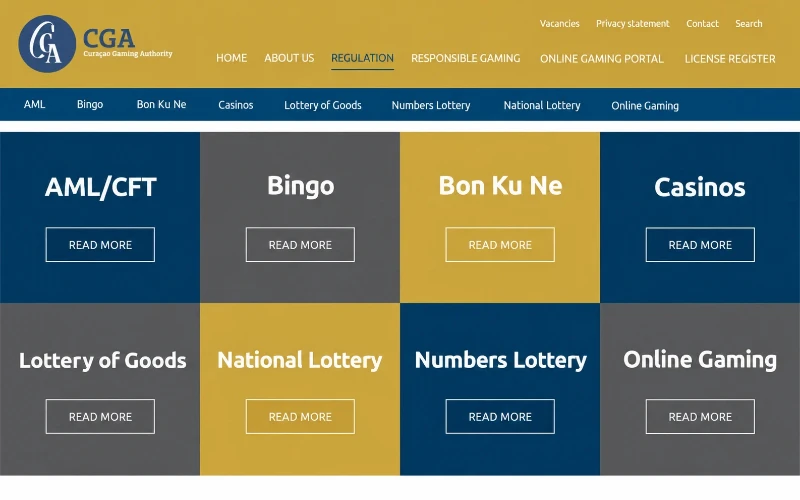
Curaçao also imposes FATF-aligned customer-identification and unusual-transaction reporting obligations, with added transaction-monitoring requirements for crypto operators. Its license doesn’t exempt crypto gambling from those checks, putting platforms marketed as fully anonymous in direct tension with the framework. “Light-touch Curaçao” describes a regime that no longer exists.
Similarly, an Anjouan license requires confirmation against the company, domain, and current status in its public register. Company registration in Costa Rica alone does not establish gambling authorization in your country.
Lighter-touch jurisdictions like these are where most “no verification” branding now sits, with weaker protection and recourse if something goes wrong.
Are Anonymous Betting Sites Without Verification Legal?
The legality of betting without document verification depends on your location, the operator’s license, and the rules that apply in your jurisdiction, a different question from what the operator must do (covered above), since a legally compliant operator elsewhere can still be off-limits to you specifically.
A license issued in one jurisdiction does not automatically authorize a bookmaker to serve customers everywhere. Check the company and website against the relevant regulator’s register, review any restricted-country list, and confirm the online betting rules that apply where you live.
A search listing, an accepted payment method, or an accessible website doesn’t by itself prove an operator is authorized in your country – all three can be true for a site you’re still not legally permitted to use.
Benefits and Risks of Betting Sites with No Verification
No-verification betting sites appeal to users who want a simpler sign-up process and less document sharing. Here, we discuss the main benefits and risks, including convenience, account protections, and possible later verification checks.
- Faster registration when no document upload or manual approval is needed
- More privacy, since fewer copies of your passport or proof of address end up with another business
- Quicker deposits, and sometimes withdrawals, when no additional documents are required
- Less friction overall, with fewer steps and fewer documents to prepare upfront
- Documents can still be requested before processing a withdrawal
- Lower regulatory protection, including weaker complaint and dispute options depending on the operator’s license
- Higher scam risk, since lighter sign-up vetting can also mean lighter vetting of the operator itself
- Deposit limits, time-outs, and self-exclusion tools can be limited or unavailable
How Anonymous Betting Sites Can Still Identify You
This section looks at how anonymity breaks down in practice, beyond the general risks covered above. An anonymous betting site doesn’t control every record tied to your activity; payments, account recovery, and disputes can all link that activity back to your identity.
Anonymous betting sites can still link bets to your identity through payments, exchanges, account recovery and disputes.
Reusing an Ethereum address, for instance, links transactions to the same wallet even without an on-chain name; Ethereum’s privacy documentation distinguishes pseudonymity from true anonymity.
An exchange creates another link. Coinbase requires identity verification at registration and periodically afterward, leaving an identified intermediary holding records of transfers to and from a betting wallet.
Large withdrawal requests or account reviews commonly trigger document checks under the operator’s terms, too. An unverified account is also harder to recover if it gets locked because, with no identity on file, the operator has fewer ways to confirm you’re really you.
And no anonymity survives a real dispute: chasing a refund or filing a complaint means handing over the same personal details and payment records you avoided at sign-up.
Overall, privacy in crypto betting depends on the full payment and account process, not just the sign-up form. Never being asked for documents doesn’t guarantee privacy, and it doesn’t guarantee a payout either.
How to Choose a Reliable No-Verification Betting Site
Choosing a bookmaker for online sports betting means checking whether it will actually pay you, not just whether it skips ID at sign-up.
- A license only counts if it’s real. The company and domain need to match an active entry in the regulator’s register, because a badge alone proves nothing
- Payment terms matter as much as the license. Which methods it supports, deposit and withdrawal limits, fees, and whatever triggers a document check decide how the site behaves once money is moving
- Market depth and odds separate a real betting site from a thin one. Bet types per match, not just leagues, and how betting odds compare on identical selections are the real signal, and live betting speed matters just as much in-play, once odds move fast
- Mobile betting access is worth testing directly, not assuming. The app or browser site, the bet slip, and account controls all differ in practice and shape your overall betting experience
- The T&Cs hold what matters most. Wagering, bonus, and account-closure clauses decide what actually happens once money is involved
Payment Methods on Betting Sites Without Verification
Four payment channels turn up across betting sites without verification: crypto, e-wallets, bank cards or transfers, and prepaid vouchers. Paperwork differs sharply between them, from a wallet address on one end to a card statement showing your name on the other.
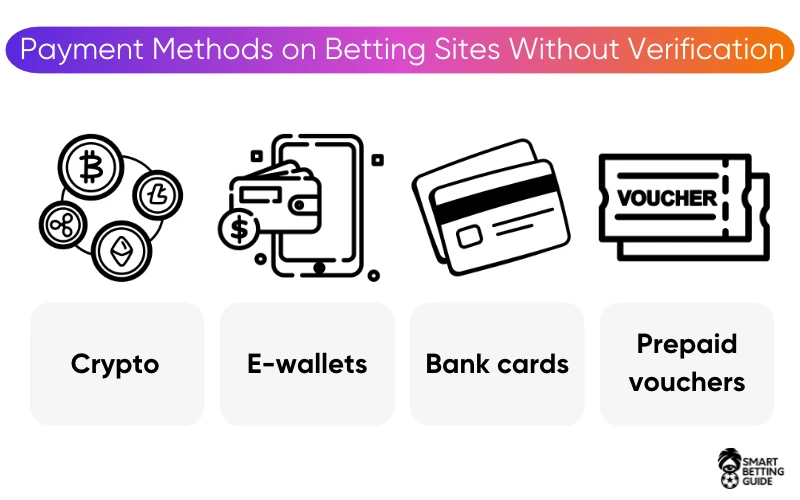
Here’s how they differ.
- Crypto (Bitcoin, Ethereum, USDT) moves through a wallet address rather than a name, though buying it via an exchange brings that exchange’s own KYC back in
- E-wallets carry whatever verification was done when the account was first opened, and that history travels with every deposit
- Bank cards and transfers put the account holder’s name on the transaction by design
- Prepaid vouchers get bought with cash, keeping a bank account out of the picture at deposit – though most operators won’t pay winnings back out through the same voucher
A bookmaker’s own account policy is separate from its payment providers’ checks. Clearing one doesn’t clear the other.
Which Deposit Methods Need the Least Paperwork?
A self-custody wallet you already hold needs no new provider-account steps, so it usually ranks lowest on paperwork; buying crypto through an exchange first adds that exchange’s own checks back in. Crypto sports betting deposit methods sit alongside bank and e-wallet accounts, which are already verified but stay linked to your identity.
Privacy Coins
Monero coin and Zcash are the two coins bettors reach for when privacy is the priority. Monero does it by default; Zcash optionally. Neither removes a betting site’s own checks. Coin-by-coin acceptance for these privacy coins sits in a dedicated guide.
Anonymous Betting Through Telegram Bots
Telegram betting bots work over chat, wallet-to-wallet, with no separate sign-up: your existing Telegram account already carries a verified phone number, so the bot asks for nothing extra. That’s what makes them fast and low-friction – and also where the risks start.
Impersonation is the biggest one: fake bots impersonating real operators are a known scam vector, and a familiar bookmaker’s name or logo on a bot doesn’t prove it belongs to that operator.
If you use a custodial balance, the service – not you – controls the deposited funds, often chosen from the same privacy-focused coins covered in our altcoin betting sites guide; they aren’t held in your own wallet. Data shared inside the chat also sits with the bot operator, not just the bookmaker.
Telegram doesn’t resolve disputes through its Bot Payments platform either; its payment documentation places responsibility with bot developers, payment providers, and banks, so you need to check the bookmaker’s complaint procedure separately, and there’s no built-in dispute process to fall back on.
As a precaution, open only the bot linked from the operator’s verified website. Check its privacy policy, who holds your funds, and how withdrawals work before paying.
Bonuses and Promotions at No-Verification Betting Sites
When comparing bonuses like a welcome offer, a free bet, or cashback, look beyond the advertised amount to the wagering requirements, minimum odds, expiry dates, and withdrawal limits. The hypothetical examples below show how these conditions affect an offer.
| Bonus example | Practical calculation | Key condition to check |
|---|---|---|
| 100% welcome bonus up to USD100 | Deposit USD100 and receive a USD100 bonus. If 10× wagering applies to the bonus alone, you must place USD1,000 in qualifying bets. | Whether wagering applies to the bonus alone or the deposit plus bonus. |
| USD20 free bet | A winning USD20 free bet at decimal odds of 2.00 returns USD20 if the promotional stake is not returned. | Minimum odds, eligible markets and whether the free-bet stake is returned. |
| 10% weekly cashback | USD200 in qualifying net losses gives USD20 cashback, assuming no lower cap applies. | How qualifying losses are calculated, the cashback cap and any wagering requirements. |
| 50% reload bonus up to USD50 | Deposit USD100 and receive USD50. If 5× wagering applies to the bonus alone, you must place USD250 in qualifying bets. | Eligible deposit methods, expiry dates, and which anonymous bets count towards wagering. |
Bonus eligibility and withdrawal verification are separate conditions, so an offer advertised without initial document checks may still require ID before a payout.
Anonymous Betting Tips
Anonymous betting still requires careful choices around privacy and account security. Below, we explain how payment methods, account settings, and everyday betting habits affect how much personal information you share.
- Payment method choice still matters within an operator’s rules. A self-custody wallet or a privacy coin, when a site accepts it, involves fewer intermediaries than a card tied to your full identity
- Deposit size matters early on. Starting small limits what you expose before you’ve had a chance to see how an operator handles withdrawals and support
- A budget set before playing is the simplest control available. It doesn’t depend on an operator’s own verification tools working as advertised
- Balances left sitting in an account carry their own risk. Withdrawing promptly means less money sits with an operator you trust by reputation rather than by full verification history
Do Anonymous Betting Sites Check Your Age?
Anonymous betting sites don’t remove age restrictions; age and identity verification are legally separate checks, even though the same evidence often covers both. One confirms you’re old enough to gamble; the other confirms who you are.
The age check itself applies everywhere with no workaround: even privacy-first, wallet-based, and offshore betting sites or casinos are expected to confirm you’re old enough to gamble under local law – 18 in most places, though a handful of jurisdictions set the bar higher. Everything else, whether that’s done electronically or with a document, depends on the operator and its jurisdiction.
A wallet, email address, or Telegram account alone proves neither your age nor your identity. “Sports betting without ID” describes a document requirement, not an exemption from age or eligibility checks.
Gamble Responsibly on Anonymous Betting Sites
Betting stays enjoyable when you treat it as entertainment, not as a way to recover losses or cope with stress, and that’s especially true on anonymous betting sites, where no ID check exists.
A few patterns are worth watching for in your own play:
- Spending more time or money than planned, session after session
- Borrowing money or selling things to keep playing
- Feeling irritable, anxious, or low when not gambling
- Lying to people close to you about how much you bet or lose
- Using gambling to escape worry, boredom, or grief
Noticing even one of these regularly is reason enough to check in with a support service.
Helplines and Support by Country
Several organisations run free, confidential helplines and live chat, and most operate around the clock.
| Country / Region | Service | Contact |
|---|---|---|
| United States | National Problem Gambling Helpline | 1-800-522-4700 (call, text, or chat) |
| United Kingdom | National Gambling Helpline (GamCare) | 0808 8020 133, 24/7 |
| Australia | Gambling Help Online | 1800 858 858, 24/7 |
| Worldwide, 250+ languages | Gambling Therapy | Free live chat at gamblingtherapy.org |

18+ Only. Play Responsibly.
Gambling can be addictive. Play for entertainment, never chase losses or risk your well-being. If gambling is affecting your life, confidential help is available.



FAQ About Anonymous Betting Sites
⭐ Can I really bet anonymously with no verification?
Complete anonymity isn’t guaranteed. Even no ID betting sites still collect account details, and payment providers or public blockchains retain their own records regardless.
⭐ Can I withdraw without verification?
Betting sites without ID verification at signup can still require identity checks before paying out. Policies vary by operator, so always check the withdrawal terms before depositing.
⭐ Is private betting or betting without verification legal where I live?
It depends on your location and the operator’s authorization; a license issued elsewhere doesn’t automatically allow a bookmaker to serve you. Check your local betting rules.
⭐ Are betting sites without verification safe?
The label alone doesn’t prove safety. Check the license, withdrawal terms, complaint procedure, and account controls; a quick registration process doesn’t prove a site protects funds or pays reliably.
⭐ Which payment methods need the least paperwork?
An existing self-custody wallet avoids opening a new payment-provider account, though buying crypto through an exchange brings that verification back in. Existing bank or e-wallet accounts also cut paperwork.
⭐ Do Telegram betting bots require ID?
It depends on the operator behind the bot. Telegram access doesn’t exempt a bookmaker from its own customer checks. Use only the bot linked from the operator’s verified website.
⭐ Does anonymous betting remove age verification?
No. Privacy claims never remove age restrictions or other applicable requirements. A wallet, email address, or Telegram account alone doesn’t prove your age or eligibility to gamble.