How to Make Money on Polymarket?
-
 Iyke Aru
 -
07 Sep 202610 min. read

If you want to learn how to make money on Polymarket, it helps to start with realistic expectations, as on-chain data suggests that only around 15–16% of traders actually end up profitable. Here, we explain how the platform works, how to read the odds, which strategies may give you an edge, and what risks to watch out for.
Table of content
Key Takeaways
- Profit comes from buying mispriced YES or NO shares, then selling higher or holding until settlement
- Only around 15–16% of wallets are profitable, with most gains concentrated among larger traders
- More consistent returns may come from maker rebates and liquidity, not just predictions
- Availability varies by country, so check whether Polymarket is accessible where you live
- A share priced at $0.62 implies a 62% chance. Winning shares settle at $1; losing shares at $0
- Polymarket is high risk. Only trade with money you can afford to lose
Can You Actually Make Money on Polymarket? (The Honest Odds)
Yes, it is possible to make money on Polymarket, but consistent profits appear to be concentrated among a small group of traders.
A Solidus Labs review of political markets between December 2025 and February 2026 found that fewer than 1% of wallets captured roughly half of all gains. This suggests that profitable trading is possible, but the results are distributed very unevenly.
Pew Research Center found a less extreme picture in its 2026 analysis of nearly 12,000 wallets over six weeks. More than half of the traders gained or lost less than $100, while the average trader spent just over $600 and finished with a net loss of under $2.
The studies cover different markets and time periods, but they point to a similar conclusion. Many casual users trade close to break-even over shorter periods, while a much smaller group builds a meaningful edge over time.
That edge usually comes from better research, faster reactions or specialist knowledge. Polymarket prices can move within seconds after new information appears, so consistently profitable traders tend to focus on a limited number of markets they understand well rather than placing trades across every available category.
Strategies for How to Make Money on Polymarket
There’s no single best Polymarket trading strategy that works for everyone.
Traders who stay profitable over time tend to specialize in one or two of the approaches below rather than spreading a small stake thinly across all of them.
| Strategy | Edge type | Capital needed | Tooling needed | Risk profile |
|---|---|---|---|---|
| Knowledge edge | Information | Low | Medium | Directional |
| Mispriced markets | Information | Low to medium | Medium | Directional |
| Limit orders & fee cuts | Structural | Any | Low | Low |
| Liquidity rewards (making) | Structural | Medium to high | Medium | Inventory risk |
| Cross-platform arbitrage | Structural | Medium | High | Execution & resolution risk |
| Copy trading | Delegated | Low to medium | Low | Inherits others’ losses |
| News & early positioning | Information | Low | Medium | Time pressure, high stress |
Trade Where You Already Understand the Market
The most cited beginner edge on Polymarket has nothing to do with charts or indicators. It comes down to staying inside categories you already understand well enough to argue that a price is wrong, not just guess a direction because a headline caught your eye.
Several experienced traders repeat a simple filter: if you wouldn’t stake your own money on a prediction independently of Polymarket, it probably doesn’t deserve a stake on Polymarket either.
Spot Mispriced Markets
Every price on Polymarket doubles as an implied probability. A contract sitting at 0.35 dollars implies a 35 percent chance the event happens, no more and no less. When independent research points to a genuinely higher probability, say 50 percent, the gap between that estimate and the market price is the edge worth trading.
That gap needs a concrete basis, a data release, a primary document, a pattern with a clear mechanism, rather than a hunch dressed up as analysis.
Use Limit Orders to Cut Fees
Market orders fill instantly but may carry a taker fee because they remove an existing offer from the order book, the list of open buy and sell orders. On Polymarket, this can reach roughly $1.75 per 100 shares near the $0.50 mark.
Limit orders wait until another trader matches them. This makes you a maker, meaning you add liquidity instead of taking it. Makers avoid the taker fee and may receive part of it as a rebate. The saving is small per trade but can add up over time.
Earn Liquidity Rewards Through Market Making
Market making involves placing limit orders near the midpoint, the price between the best available buy and sell offers. These orders add liquidity and may qualify for liquidity rewards or daily maker rebates funded by taker fees.
Rates vary by category and can change, so any quoted percentage is only a snapshot. The main downside is inventory risk: if an order fills and the market moves against it, the maker may be left holding a losing position.
Explore Polymarket Arbitrage Across Platforms
When the same event has different prices on Polymarket and Kalshi, a CFTC-regulated prediction market, a trader can buy the cheaper position on one platform and the opposite position at a better price on the other. When the combined cost is below $1, the difference may become a locked-in profit.
These gaps often close within seconds as other traders notice them, making speed and sufficient liquidity important. The market wording must also match exactly. Different deadlines, data sources or resolution rules can turn an apparent arbitrage opportunity into losses on both platforms. This makes cross-platform arbitrage lower risk, but not risk-free.
Consider Copy Trading, With Real Caveats
Mirroring a proven wallet’s trades looks like the easiest entry point into Polymarket, and plenty of tools now offer to automate exactly that. The obvious catch rarely gets mentioned upfront: copying a trader means inheriting their losing positions too, and a strong track record over one period says surprisingly little about the next.
Paid copy-trading subscriptions and bots of uneven quality have multiplied around Polymarket recently, and none are worth naming here. Copy trading works best for exposure to categories outside a trader’s own expertise, not as a passive income stream.
Trade Breaking News Early
Prices on Polymarket lag breaking news by anywhere from a few seconds to several minutes, and freshly listed markets often open with thin order books and rough pricing before enough traders arrive to sharpen them.
A well-researched trader who moves fast in that window holds a real, if brief, advantage over the rest of the book. It is not a relaxed way to trade; it demands speed, constant attention, and a tolerance for acting on incomplete information under real-time pressure.
A Word on Airdrop Farming, Bots and Perpetuals
Polymarket’s own marketing team confirmed in late 2025 that a native POLY token and an airdrop are coming, though no date, supply figure, or eligibility criteria had been published as of mid-2026.
Some traders have reportedly tried multi-wallet and wash-trading tactics to inflate a future allocation; both violate Polymarket’s terms and leave a visible trail on-chain, risking disqualification rather than any reward.
Trading bots exist for arbitrage and market making, but a bot only amplifies a strategy that already has a genuine edge, and running one on a strategy that doesn’t work simply loses money faster.
Leveraged, perpetual-style positions are reportedly rolling out on a waitlist basis, and leverage cuts both ways, magnifying losses exactly as it magnifies gains, which puts it firmly in advanced, high-risk territory.
Risk and Bankroll Management
Bankroll management matters as much as strategy because even a genuine edge can fail when positions are too large.
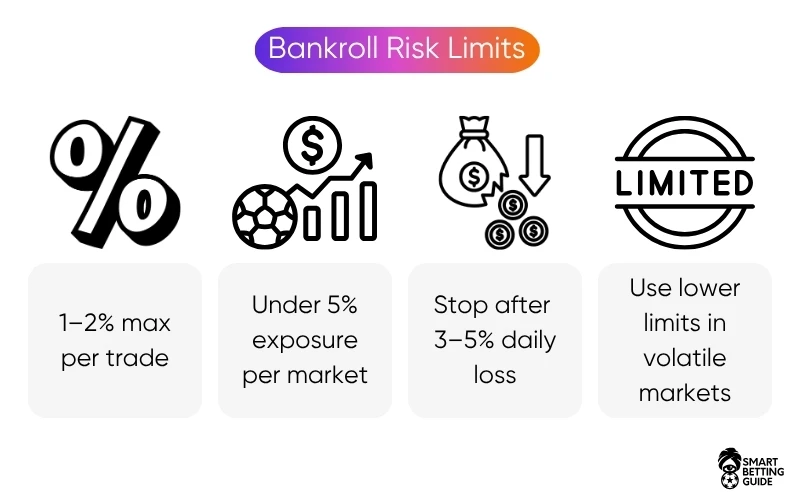
A cautious starting framework is to risk no more than 1–2% of your bankroll on one trade, keep total exposure to a single market below 5%, and stop trading after losing 3–5% in one day. These are practical limits rather than universal rules and should be reduced in volatile or thinly traded markets.
Before entering, compare your estimated probability with the market price to calculate expected value.
The Kelly criterion can then estimate an appropriate position size based on that edge, although many traders use only one-quarter or one-half of the suggested amount because probability estimates are rarely precise. High confidence alone is not a reason to increase a position, and chasing losses with larger trades usually compounds the damage.
Resolution risk also deserves attention.
Polymarket uses the UMA Optimistic Oracle: anyone can propose an outcome, and others can dispute it during the challenge period. Disputed markets may eventually be decided through a vote by UMA token holders. The decision follows the market’s stated source, deadline, and wording, not what traders assumed the question meant.
A correct real-world prediction can therefore still lose if the resolution criteria were misunderstood. Only trade money you can afford to lose completely.
Polymarket Fees and Costs
Costs on Polymarket come from three places: taker fees charged on trades, maker rebates that pay some of that back, and small network costs tied to the underlying blockchain.
Taker fees are charged per category rather than as one flat rate, peaking when a contract trades close to the 50-cent mark and shrinking toward zero near the extremes.
Geopolitics markets carry no fee at all, while categories such as crypto sit at the higher end of the range. Limit orders avoid the taker fee entirely and earn a rebate instead, funded from the fees other traders pay.
Fee schedules have shifted before without much warning; sports fees moved from roughly 3 percent to 5 percent earlier in 2026.
Checking Polymarket’s official fees page before relying on any fixed number, including the ones below, is worth the two minutes it takes.
| Item | Detail |
|---|---|
| Taker fee | Up to roughly 1.75 USD per 100 shares, category dependent, zero on geopolitics markets |
| Maker rebate | Roughly 15 to 25 percent of collected taker fees, paid daily |
| Deposit currency | USDC on Polygon (global platform), or USD by bank or card (Polymarket US) |
| Typical deposit time | A few minutes for USDC; instant to a few days for card or bank transfers |
| Typical withdrawal time | Seconds for USDC on Polygon; several business days for bank withdrawals |
How to Get Started on Polymarket
Confirming that Polymarket is available and legal in your location comes before anything else on this list.
The steps below are split by platform, since the global site and the US product work in genuinely different ways.
Global Platform (Where Available)
- Confirm your country isn’t on Polymarket’s current restricted list
- Create an account with an email address or a Google login, then connect a supported crypto wallet
- Deposit crypto. If you already use crypto betting sites, the funding process will feel familiar: deposit supported crypto and Polymarket converts it into USDC automatically
- Choose a market and read its resolution criteria in full before committing any money
- Place a limit or market order, then monitor and manage the position through to resolution
Polymarket US (for US Residents)
- Confirm your state currently permits access, since the picture varies and keeps shifting
- Register through the approved broker or app and complete identity verification
- Fund the account in US dollars through a linked bank account or card
- Trade within the approved contract categories available on the US product
For a slower walkthrough of the first deposit and first trade, our Polymarket beginner’s guide covers the platform’s interface step by step.
Where Is Polymarket Available? (Regional Restrictions)
Polymarket effectively runs as two separate products, and where each one operates differs sharply enough to catch newcomers off guard.
Polymarket in Europe
The global platform, built around crypto wallets and USDC, has been blocked for US IP addresses since a 2022 settlement with the CFTC.
As of mid-2026, it’s also restricted in more than 40 other jurisdictions, including France, Germany, Italy, Belgium, Poland, Switzerland, Portugal, Hungary and Singapore, alongside OFAC-sanctioned countries such as Russia, Iran and North Korea.
France’s gambling regulator ordered nationwide internet provider blocks in July 2026, concluding that earlier restrictions on financial transfers alone hadn’t kept residents off the platform.
Polymarket in the USA
Polymarket US, operated through QCX LLC, launched as a federally regulated exchange in late 2025 and is technically legal across all 50 states under CFTC oversight.
Several individual states disagree. Minnesota’s SF4760, signed in May 2026, makes operating a prediction market a state felony from the first of August, and Nevada, Tennessee, Arizona, Connecticut, and Wisconsin have each pursued their own enforcement action or cease-and-desist order against prediction market operators this year.
Alternatives to Polymarket
Polymarket is not the only prediction market available. Kalshi is the closest direct alternative for US users, offering dollar-denominated event contracts through a CFTC-regulated exchange. It suits traders who prefer standard bank funding, identity verification and federal regulatory oversight.
PredictIt is another option focused mainly on political events, while Manifold Markets uses play money and is better suited to practising forecasts without risking real funds.
The best choice depends on your location, preferred payment method and the markets you want to trade. Availability and local rules can change, so check each platform before registering. Whichever venue you use, long-term results depend more on research, pricing discipline and risk control than luck.

18+ Only. Play Responsibly.
Gambling can be addictive. Play for entertainment, never chase losses or risk your well-being. If gambling is affecting your life, confidential help is available.



FAQ About Making Money on Polymarket
⭐ Is it actually possible to make money on Polymarket?
Yes, but profitable traders appear to be a minority. Research suggests only around 15–16% of wallets make money consistently.
⭐ What percentage of Polymarket traders are profitable?
Independent analyses put the figure at roughly 15–16%. Most profits are concentrated among a relatively small group of traders.
⭐ How much money do I need to start trading on Polymarket?
There is no fixed minimum beyond trade size and small fees. Around $20–$50 is a practical amount for beginners.
⭐ What's the lowest-risk way to earn on Polymarket?
Using limit orders and earning maker rebates can be lower risk than simply predicting outcomes, although losses are still possible.
⭐ Is Polymarket gambling or investing?
Polymarket has elements of both. It involves market analysis and trading, but contracts still settle on binary real-world outcomes.
⭐ Is Polymarket legal in my country?
It depends on local laws. Polymarket is restricted in many jurisdictions, so users should check both platform rules and local regulations.
⭐ Can US residents use Polymarket?
Yes, through Polymarket US, which operates as a regulated exchange and requires identity verification and USD funding.
⭐ Do I have to pay tax on Polymarket profits?
Usually yes, but the exact tax treatment depends on local law. Profits may be treated as investment income, miscellaneous income, or gambling winnings.

Crypto Content Writer