What is Kalshi and How Does it Work?
-
 Dalius Mikalauskas
 -
24 Aug 20269 min. read

What is Kalshi and how does it work? Kalshi is the first federally regulated event contract exchange in the US. You trade simple yes-or-no contracts on real-world events, like elections or interest rates. Two MIT graduates started it in 2018, and the Commodity Futures Trading Commission regulates it.
In this guide, we cover the basics, the markets, the legal fight, and how to begin.
Table of content
- Key Takeaways
- What Is Kalshi Prediction Market?
- How Does Kalshi Work?
- What Can You Trade On Kalshi Markets?
- How Is Kalshi Different From Sports Betting?
- How Do You Get Started On Kalshi?
- What Are The Risks Of Trading On Kalshi?
- Is Kalshi Legal And Regulated?
- What's Happening With Kalshi Now?
- The Bottom Line on Kalshi
Key Takeaways
- Kalshi is regulated by the CFTC as a financial exchange, not a bookmaker or a casino
- The price shows how likely the market thinks an outcome is
- A winning contract pays 1.00 USD, so a contract bought at 0.40 USD gives you 0.60 USD of profit
- Tarek Mansour and Luana Lopes Lara, two MIT graduates and former quant traders, founded Kalshi
- Sports markets now drive more than 90% of trading on the platform
- Kalshi’s legal status is not settled, and several state cases may reach the Supreme Court
What Is Kalshi Prediction Market?
Kalshi is a US-based, federally regulated exchange where you trade event contracts. An event contract is a simple yes-or-no contract on a real-world outcome, bought and sold like a stock. Take a question like “Will the Federal Reserve cut rates in December?” You buy “yes” or “no”, and the price moves as opinions change.
Two MIT graduates, Tarek Mansour and Luana Lopes Lara, founded the company in 2018. Both had worked as quant traders at firms like Goldman Sachs and Citadel.
They spent more than two years chasing approval before listing a single contract. In November 2020, the Commodity Futures Trading Commission gave Kalshi its designated contract market license. That made it the first regulated platform built to trade directly on event outcomes. Kalshi opened to the public in July 2021.
That slow, legal route shaped the whole product. The founders wanted to turn opinions about the future into a regulated market, rather than the offshore, crypto-based setup most rivals use.
One point matters. Kalshi is a regulated derivatives exchange, not a betting site. The difference between an event contract and a wager sits at the heart of almost every debate about the company.
How Does Kalshi Work?
Kalshi lets you trade binary event contracts. Each market asks one question with a clear yes or no answer and a set end date. When the question is settled, the contract pays exactly 1.00 USD if your side was right and 0.00 USD if it was not.
The price is easy to read. Every contract trades between 0.01 USD and 0.99 USD, and that price shows how likely the market thinks the event is. A “yes” contract at 0.65 USD means about a 65% chance. Prices move as news comes in, just like a stock.
Your profit is the gap between what you paid and the 1.00 USD payout. Buy at 0.40 USD, guess right, and you get 0.60 USD per contract, minus fees. Guess wrong, and you lose the 0.40 USD you put in.
You do not have to wait for the end. You can sell early to lock in a gain or cut a loss, using a market order or a limit order at your chosen price.
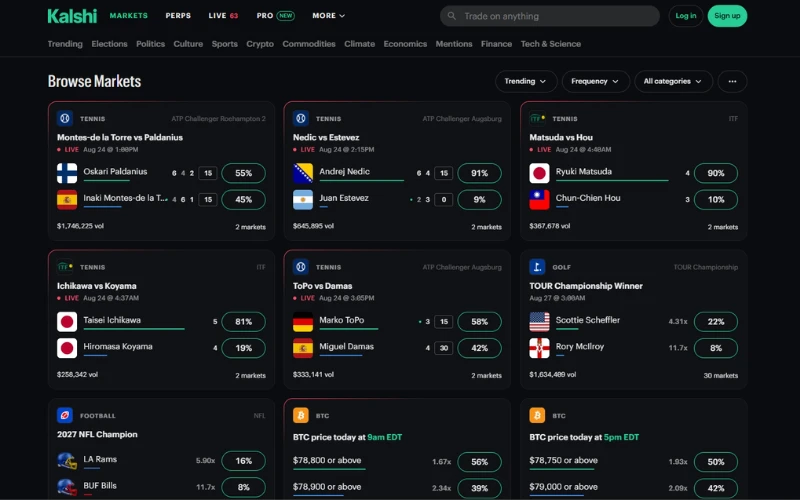
The setup is peer-to-peer. Kalshi just matches buyers and sellers on an order book. It never takes the other side of your trade, unlike a sportsbook, where the house wins when you lose.
Instead, Kalshi earns a small fee on each trade, about 0.02 USD per contract. The exchange makes money on trading volume, not on your losses.
Worked example. You buy 100 “yes” contracts at 0.40 USD each, so you stake 40 USD. The event resolves “yes”, so each contract pays 1.00 USD and you get 100 USD back. That is 60 USD of profit before the fee. If it had resolved “no”, the contracts would be worth zero and you would lose the 40 USD.
How Are Event Contracts Different From Traditional Trading?
Event contracts differ from stocks and options in three ways. The result is yes or no, so a contract ends at either 1.00 USD or 0.00 USD, nothing in between. Your top gain and loss are fixed the moment you trade. Each market also has an end date, after which the contract is gone.
What Can You Trade On Kalshi Markets?
Kalshi lists markets in several broad areas, and the range is part of the appeal. One day you trade on an interest rate decision, the next on a hurricane. Sports is now the biggest area, though the platform started well outside it.
Here are the main areas and the kind of questions each one covers.
| Category | Example markets |
|---|---|
| Economics and finance | Interest rate decisions, CPI inflation prints, jobs reports, S&P 500 levels |
| Politics and policy | Elections, legislative outcomes, government shutdowns, confirmations |
| Sports | Game winners, player props, championship futures |
| Culture and entertainment | Award show winners, box office milestones, chart positions |
| Weather and climate | Temperature records, hurricane landfalls, snowfall totals |
| Technology and crypto | Product launches, company milestones, crypto price thresholds |
Sports now makes up more than 90% of activity, and it is also the most fought-over in court. Economic and weather markets are a real strength, and some, like CPI and Fed-rate contracts, exist nowhere else. Kalshi adds and drops markets often, so kalshi.com is the place to check what is live.
How Is Kalshi Different From Sports Betting?
Many people think Kalshi is just betting with extra steps. It looks similar at first, but the legal and structural base is different.
The table below shows the main contrasts.
| Aspect | Kalshi | Traditional bookmaker |
|---|---|---|
| Regulator | CFTC (federal) | State gambling commissions |
| Market structure | Peer-to-peer exchange | House is the counterparty |
| Pricing | Set by supply and demand | Set by the book, with a built-in margin |
| Product type | Event contracts (derivatives) | Wagers |
| Availability | Aims for nationwide federal access | State-by-state legalization |
| Scope | Politics, economics, sports, weather, culture | Mostly sports and casino games |
The peer-to-peer model changes the incentives. Traders sit on opposite sides of each other, not against Kalshi. The exchange does not care whether you win or lose. Its only goal is trading volume, which is why the fee sits on the trade, not on your losses.
Kalshi’s legal argument comes from that structure. It says an event contract is a federally regulated derivative under the Commodity Exchange Act, and so not gambling in law. State regulators disagree. They argue that a contract on which team wins still works like a bet, whatever you call it.
How Do You Get Started On Kalshi?
Getting started on Kalshi is more like opening a brokerage account than signing up for a betting app.
The steps below run in order:
- Create an account. Sign up at kalshi.com with your email and basic details. You must be a US resident and at least 18, or 21 in a few states
- Verify your identity. Kalshi asks for your name, address, date of birth, and Social Security number, like any regulated exchange. This usually clears fast, but it can take up to about 48 hours
- Fund your account. There is no set minimum, but about 20 USD gives you room for a few trades. Bank transfers (ACH) are free, debit cards charge 2% but land instantly, and large sums go by wire
- Explore the markets. Browse by category and read each market’s rules summary. It sets out the exact question, the data source, and the end date, so there is no confusion later
- Place your first trade. Pick yes or no, set how many contracts, check the fee, and confirm. Watch your open positions, then sell early or hold to the end, as you prefer
What Are The Risks Of Trading On Kalshi?
Event contracts carry real financial risk, and a beginner guide should say so plainly. You lose your whole stake on any contract that goes against you, because the result is yes or no. Smaller markets are often thin, so wide gaps in price eat into your returns.
Resolution rules are strict, so read them. A market asking “Will inflation top 3%?” names the exact report and number that settles it.
Legal risk is real too, since the state disputes can affect who gets access. Taxes are unsettled as well. Experts disagree on whether gains count as trading income, Section 1256 contracts, or gambling, so ask a tax adviser.
There is a behavior risk too. Fast markets tempt you to over-trade, and quick results make it easy to chase losses. Only trade with money you can afford to lose, and set limits before you start.
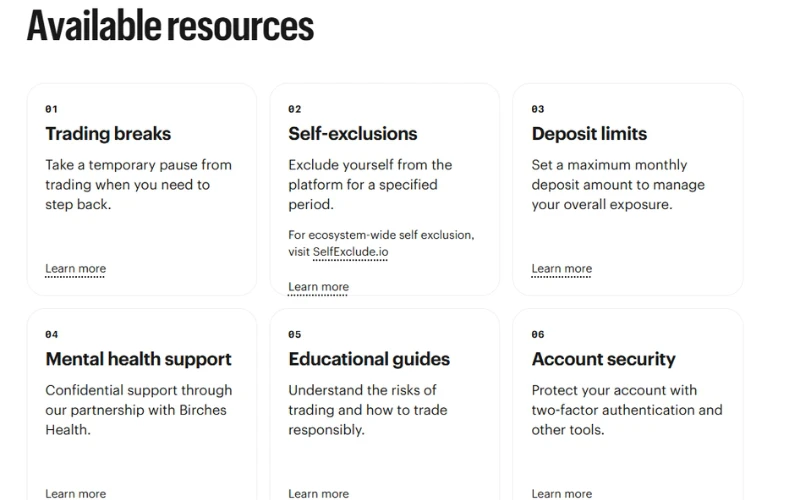
For that reason, Kalshi offers deposit limits, session reminders, and self-exclusion tools. The platform is for adults only, 18 or older and 21 in some states. Anyone in the US who feels their trading or gambling is out of control can call the National Problem Gambling Helpline on 1-800-GAMBLER.
Is Kalshi Legal And Regulated?
Kalshi runs as a CFTC-regulated designated contract market. That is the federal system for derivatives and futures trading, and it is the basis for Kalshi’s claim to operate nationwide. On the ground, though, the picture is unsettled and changing fast.
The regulatory history is worth following in order.
- 2020, the CFTC grants Kalshi its designated contract market license
- 2021, the platform opens to the public
- Late 2024, a federal court rules Kalshi’s political contracts are not illegal gambling, so the CFTC allows election markets
- Early 2025, Kalshi launches sports contracts, and state gaming regulators quickly push back with cease-and-desist orders
- Through 2026, the courts split. A Tennessee court sided with Kalshi in February, an Ohio judge called its products gambling in March, and Arizona filed criminal charges the same month
The biggest ruling so far came from an appeals court. In April 2026, the U.S. Court of Appeals for the Third Circuit ruled that Kalshi’s sports contracts count as “swaps” under the Commodity Exchange Act. It also ruled that federal law overrides New Jersey’s gambling laws. This was the first federal appeals decision on the question.
Around the same time, the CFTC and the Justice Department sued Arizona, Connecticut, and Illinois to defend federal control. A separate case out of Nevada was before the Ninth Circuit.
Here is the honest picture as of mid-2026. Kalshi says its contracts should follow one federal rulebook across all 50 states, and one appeals court has agreed. Several states, however, have blocked or challenged its sports markets, including Arizona, Illinois, Massachusetts, Maryland, Michigan, Nevada, and Ohio. The platform is not available in all of them right now.
The courts may end up disagreeing, which would likely send the issue to the Supreme Court. For now, treat any claim that Kalshi is “legal everywhere” or “banned” as too early. Check the current rules for your state before you trade, because this changes month to month.
What’s Happening With Kalshi Now?
Kalshi has grown fast. Its political markets saw heavy trading during the 2024 US presidential election and were watched as a forecast of the result. The 2025 launch of sports contracts drove huge growth. It also set off the wave of state lawsuits now working through the courts.
The money has followed. A late-2025 funding round valued Kalshi at 11 billion USD and made both founders billionaires, and 2026 reports put a later figure much higher.
The company has also linked up with brokerages like Robinhood and Webull, and with media and sports partners. This part dates fast, so check recent news for the latest.
The Bottom Line on Kalshi
What is Kalshi and how does it work, in one line? Kalshi is a federally regulated prediction market where you trade yes-or-no event contracts on real-world outcomes. The price reads as a probability, and a winning contract pays 1.00 USD.
It differs from a sportsbook through its peer-to-peer model and CFTC oversight, but the legal fight over its sports markets is far from over. Learn how it works, respect the risk, and check the rules for your state before you put in any money.
FAQ About Kalshi
⭐ Is Kalshi a betting site or a trading platform?
Kalshi meaning refers to a trading platform, a CFTC-regulated designated contract market. Traders buy and sell event contracts on an order book, not wagers placed against a house.
⭐ Do I need to be a US citizen to use Kalshi?
You do not have to be a citizen, but you must be a US resident with a real home address. PO boxes are not allowed, and every account goes through identity checks. You must also be at least 18, or 21 in some states.
⭐ How much money do I need to start trading on Kalshi?
There is no fixed minimum, so you can fund an account with almost any amount. About 20 USD is a practical start, enough for a few trades across different markets. Only deposit money you can afford to lose.
⭐ What fees does Kalshi charge?
Kalshi prediction market platform charges about 0.02 USD per contract. The fee is highest near the middle of the price range and smaller toward the edges. There is no membership fee and no settlement fee.
⭐ How are winnings from Kalshi taxed?
Tax treatment is not settled. Experts disagree on whether gains count as ordinary income, Section 1256 contracts, or gambling income, and the answer changes how much you pay. Ask a tax adviser about your own case.
⭐ Is my money safe on Kalshi?
Customer money is held in separate accounts at regulated banks, which Kalshi’s CFTC registration requires. That protects your deposit, but not against trading losses. Every contract can still settle at zero.
⭐ What happens if a Kalshi market fails to resolve?
Each market publishes rules that name its data source and a backup if that data does not appear. If an event is canceled or cannot be settled, the market is voided and stakes are returned.

Crypto and Sports Betting Expert