Polymarket & Prediction Markets Explained 2026
-
 Dalius Mikalauskas
 -
24 Aug 202614 min. read

For a clear explanation of “what is polymarket and how does it work”, you’re in the right place — it’s one of the most talked-about prediction market platforms right now.
We’ve put together this guide for understanding Polymarket — from the basics of how Polymarket works to the mechanics behind each trade, covering Polymarket’s meaning in full.
Table of content
- Key Takeaways
- What Is Polymarket and How Does It Work?
- How Does Betting on Polymarket Work?
- Key Concepts: Markets and Events
- How to Trade on Polymarket?
- What Happens When a Market Resolves?
- Blockchain, Wallets, and Self-Custody
- Risks & Considerations (Smart Contract, Wallet, Market)
- Advanced Features and Opportunities
- Polymarket vs Competitors
- Why Decentralized Prediction Markets Matter
- Polymarket Summary
Key Takeaways
- Polymarket is a decentralized market for betting on outcomes of real-world events
- Share prices from USD 0.01 to USD 0.99 show the market’s estimated chance
- Every trade is between users — there’s no house taking the other side
- The platform runs on the Polygon blockchain and uses USDC as its currency
- Results are settled through UMA’s Optimistic Oracle, not one central company
- Polymarket is not available everywhere, and you can lose real money
What Is Polymarket and How Does It Work?
Polymarket is a decentralized prediction market platform built on Polygon, a Layer 2 network on Ethereum. Polymarket betting is a place where you can put real money on whether something will happen, and each “share” price shows what the crowd thinks the odds are.
It’s worth clearing up a few things people often mix what is Polymarket betting with:
| Platform type | What it trades | Who are you up against |
|---|---|---|
| Traditional bookmaker | Sports outcomes | The house (operator) |
| Polymarket crypto exchange | Equity, tokens, assets | Other market participants |
| Poll or forecasting site | Opinions (no money involved) | Nobody — it’s a survey |
| Polymarket | Real-world event outcomes | Other users (peer-to-peer) |
The collateral asset on Polymarket is USDC — a U.S. dollar backed by USDC stablecoin — making all positions stable against dollar value. So when you deposit and trade, everything is priced in dollars. Once you understand that, trading makes much more sense.
How Does Betting on Polymarket Work?
Understanding the mechanics helps you use the platform well. There are three things to know: how shares work, who you’re trading against, and what a price actually means.
To understand “how does a polymarket bet work”: every market is structured as a binary, yes-or-no question — that’s the core polymarket bet meaning. For example, “Will this team win?” Users can trade by choosing to purchase shares in the answer they think is right.
Here’s how do polymarket bets work in terms of payouts:
- A Yes share pays USD 1.00 if the answer is Yes, and USD 0.00 if the answer is No
- A No share pays USD 1.00 if the answer is No, and USD 0.00 if the answer is Yes
- Share prices range from USD 0.01 to USD 0.99
The price you pay is the most you can lose on a single share. If your prediction is right, the share pays USD 1.00. So, your profit is USD 1.00 minus the price you paid for that share.
The Peer-to-Peer Model (No House)
Polymarket doesn’t take the other side of your trades. Every time you buy a Yes share, someone else is selling it — and they’re effectively holding the No position. The platform matches buyers and sellers, much like a stock exchange.
This is a meaningful difference from traditional bookmakers.
With traditional betting platforms, the operator builds a margin into the betting odds and profits regardless of the outcome. Polymarket never acts as your counterparty — another user is, which means every Polymarket trade is fully peer-to-peer.
Price as Probability: A Bitcoin Example
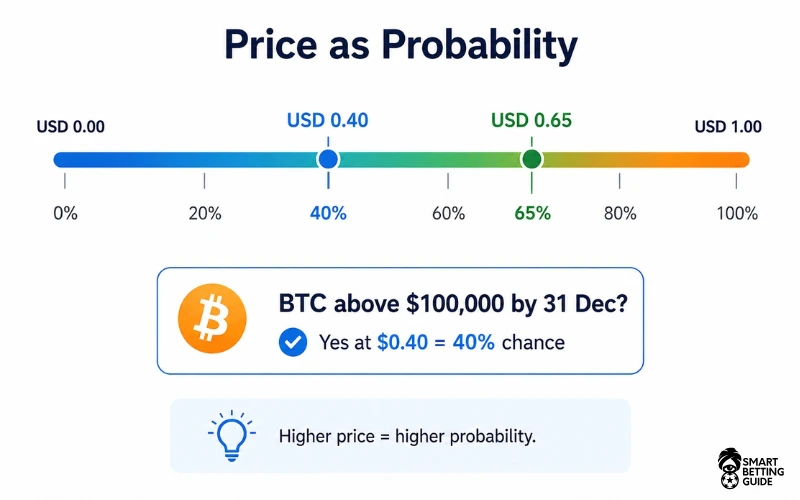
The price of a share is a direct probability assessment — prices reflect what the crowd collectively believes. A USD 0.65 share means the market estimates a 65% chance.
For example, if a market asks “Will Bitcoin close above USD 100,000 by 31 December?” and Yes shares cost USD 0.40, it suggests about a 40% chance. If news pushes sentiment higher, buyers bid the price up, and odds shift as the implied probability moves with it.
Key Concepts: Markets and Events
Polymarket organizes its content into two levels — individual markets and broader events. Once you know the difference, navigating the platform becomes much easier, and you’ll spend less time guessing where to find what you’re looking for.
A market is a single binary question with a fixed resolution date and a defined resolution source. An event is a collection of related markets grouped under one topic.
For multi-outcome questions, such as “2028 US Presidential Election”, Polymarket creates one Yes/No market per candidate rather than a single multi-choice market.
This lets you trade on one specific outcome without being exposed to the others. Here’s how the two concepts compare in practice:
| Market | Event | |
|---|---|---|
| What it is | Group of related markets | Group of related markets |
| Example | “Will the Fed cut rates in December 2026?” | “Oscar Best Picture 2026” (market per nominee) |
| Resolution | Set upfront (e.g., official notice) | Each market has its own |
| Duration | Hours to years | Varies across markets |
| How to find | Browse by category or search | Click an event title |
Always read the resolution source before buying into a market, as it defines exactly what counts as a Yes outcome. Within an event, related market prices should roughly add up to USD 1.00. If they don’t, it may signal a mispricing worth checking.
How to Trade on Polymarket?
Getting started on Polymarket is simpler than it seems, even if you’ve never used a crypto wallet. We’d recommend following these steps in order, especially if it’s your first time.
Getting Started on Polymarket
Before you can trade, you need to set up an account and fund it. The whole process takes around ten minutes if you already hold USDC — a little longer if you need to buy it first.
- Go to polymarket.com. You can access the platform from a desktop browser or a mobile device — no app download is required
- Create an account. Sign up with your email address or connect an existing crypto wallet. Email sign-up is the simpler route for beginners
- Set up your wallet. You can create an embedded wallet in the app or connect an external wallet, such as MetaMask or Coinbase Wallet. The embedded option is easier, while the external option gives you more control over your funds
- Deposit USDC on the Polygon network. All trading on Polymarket covers real-world events using USDC. Ensure you’re sending funds on the Polygon network specifically — sending on the wrong network means your deposit won’t arrive
Always verify the current onboarding flow at polymarket.com before depositing — the wallet setup process has changed before and may change again.
Once your account is funded, placing a trade is straightforward. Browse the markets first to see how they’re structured and priced before you commit any money.
- Browse and select a market. Markets are grouped by Politics, Crypto, Sports, Culture, and more. Click any market to see price, volume, and resolution details
- Choose your position. Decide whether you want to buy Yes shares or No shares. Before committing any money, read the resolution source in the market description carefully, as it defines exactly what outcome triggers a payout
- Enter your amount. Set how much USDC to spend or the number of shares you want. The interface shows the average price and your potential payout at resolution
- Review and place your order. Check the price, total cost, and potential payout carefully, then submit the order once everything looks right
- Approve the transaction in your wallet. Gas fees on Polygon are minimal — typically a fraction of a cent — so this step won’t add any meaningful cost
Using the Order Book (CLOB)
Polymarket uses a Central Limit Order Book, or CLOB, which is the same type of trading system used by many traditional financial exchanges to match buyers and sellers.
Understanding the difference between order types can affect the price you end up paying:
- Market orders are executed immediately at the best available price. They’re convenient but can result in a slightly worse price in low-liquidity markets
- Limit orders let you set the exact price you’re willing to pay and wait for a match. Useful if you think the current price is slightly off and are willing to be patient
Liquidity can vary widely across markets. Popular political or crypto markets, driven by active users, usually have tight spreads and deep order books. Niche or new markets may have wider spreads, increasing your effective entry cost before you trade.
Exiting Positions Before Resolution
You don’t have to hold a position until the market resolves. At any time before the resolution date, you can sell your shares on the open market at the current price. This means you can:
- Lock in a profit if the price has moved in your favor
- Cut a loss if new information changes your view
- Free up capital so you can deploy it in other markets
What Happens When a Market Resolves?
When a market’s deadline passes, it needs to be resolved — meaning shares either pay out USD 1.00 or expire at USD 0.00. Polymarket doesn’t make that call itself.
Instead, Polymarket uses oracles to verify outcomes — specifically UMA’s Optimistic Oracle, a decentralized system for deciding real-world outcomes. The process is trustless, so no single party decides the result, and anyone can challenge an outcome they believe is wrong.
The resolution process usually moves through three simple steps:
- A proposer submits the outcome. Based on the resolution source specified in the market, a proposer puts forward the result — Yes or No
- A challenge window opens. This typically lasts a few hours. During this time, anyone can dispute the proposed outcome if they believe it’s incorrect
- The outcome is confirmed or voted on. No dispute means automatic finalization. If someone challenges it, UMA token holders — acting as a market integrity committee — vote to decide which outcome is correct under the market rules
Once a market resolves, settlement is automatic. Winning shares pay USD 1.00 each into your Polymarket balance, ready to withdraw or reuse. Losing shares settle at USD 0.00.
Edge cases can still happen. Markets with unclear or contested conditions may take longer to resolve or lead to disputed outcomes. These situations are uncommon, but they’re worth keeping in mind when the Yes/No boundary is not fully clear-cut.
Blockchain, Wallets, and Self-Custody
Polymarket runs entirely on-chain via Polygon, an Ethereum Layer 2 network in the decentralized finance space. That means transactions are fast, gas fees are minimal, and every trade is recorded on a public blockchain, making it auditable and transparent.
Self-custody sets Polymarket apart from centralized platforms. You hold your own USDC in a self-custodial setup. The platform doesn’t pool or hold your funds in the traditional sense.
There are two wallet setups — Embedded and External — to choose from:
| Embedded Wallet | External Wallet | |
|---|---|---|
| Setup | Created directly in Polymarket | Connect existing wallet (e.g., MetaMask) |
| Best for | Beginners | Users who are comfortable with crypto |
| Recovery | Email-based | Seed phrase — your responsibility |
| Control | Managed partly by the app | Fully self-custodied |
| Access lost | Recoverable via email | Funds lost without a seed phrase |
The tradeoff is simple: self-custody protects you if the platform fails, but you manage the wallet. Lose your seed phrase with no recovery option, and the funds are gone for good.
Neither setup is risk-free — they simply carry different types of risk, and it’s worth choosing the one that matches your comfort level and experience.
Risks & Considerations (Smart Contract, Wallet, Market)
Polymarket prediction markets carry real risks that are easy to overlook when you’re focused on a market you feel confident about. Thus, we’d encourage you to read this risks and considerations list carefully before depositing anything:
| Risk | What it means |
|---|---|
| Financial | You can lose your entire stake, including any trading fees, on any given market. Only commit what you can afford to lose. |
| Market volatility | Prices can move sharply on breaking news. A position that looks good in the morning can look very different by the afternoon. |
| Resolution | Ambiguous or contested events can result in disputed outcomes and delayed settlements. |
| Smart contract | Polymarket’s contracts have been audited, but no smart contract is completely immune to vulnerabilities. |
| Wallet security | Losing your private key or seed phrase means losing your funds permanently, with no recourse. |
| Regulatory | Polymarket’s availability varies by country and has been restricted for retail users in the US. Always check your local laws before participating. |
| Liquidity | In less popular markets, you may struggle to exit a position at a fair price. |
This article is for informational purposes only and does not constitute financial, legal, or investment advice. Always do your own research and consult a qualified professional before participating in Polymarket prediction markets.
Advanced Features and Opportunities
Beyond basic trading, users trade across broader tools and market types worth knowing about. This isn’t a full guide to every feature, just a quick overview of what’s available.
Multi-Market Events
For major events like elections or sports tournaments, Polymarket often runs several related markets at once. Experienced traders compare these markets to spot pricing inconsistencies or hedge their positions, such as taking opposing positions in linked outcomes.
Sports Markets
For those wondering “how does Polymarket work for sports betting”, it has expanded strongly, with high trading volume across match outcomes, championship winners, season-long markets, tournament results, and individual performance milestones.
Developer Tools and APIs
For builders and quantitative traders, Polymarket offers a public CLOB API and data feeds. These allow you to pull market data, automate trading strategies, or build tools on top of the platform. Documentation is available via the Polymarket developer docs.
Token Incentives
Polymarket has run airdrop programs in the past. If you’re interested in what’s currently live or confirmed, check the official Polymarket channels directly — we’d caution against trading strategy decisions based on unconfirmed airdrop speculation.
Polymarket vs Competitors
Polymarket prediction market isn’t the only option out there, and depending on where you live or what you want to trade on, one platform may suit you better than another.
The three most commonly compared options are Polymarket, Kalshi, and Manifold Markets — each built on a different model and serving a somewhat different audience.
Here’s how the mentioned prediction markets compare with each other:
| Feature | Polymarket | Kalshi | Manifold Markets |
|---|---|---|---|
| Jurisdiction | Global (with restrictions) | US-regulated (CFTC) | Global |
| Underlying tech | Polygon blockchain | Centralised exchange | Centralized + play money option |
| Collateral | USDC | USD | Mana (play) / real on some markets |
| Market types | Politics, crypto, sports, culture | Economics, politics, weather, sports | Wide range, user-created |
| Self-custody | Yes | No | No |
| Regulatory status | Varies by region | CFTC-regulated | Mostly play money |
Polymarket’s main advantages are decentralization, blockchain transparency, and deep liquidity in political markets. If you’re outside the US and want to trade on major events without a centralized intermediary, it’s the most established option available.
Kalshi has a meaningful edge for US-based users who want regulatory clarity. It’s CFTC-regulated, operates in USD, and doesn’t require crypto knowledge. For traders who prioritize a regulated environment over decentralization, that matters.
Manifold markets suit a different use case altogether — lower-stakes, experimental, and community-created markets. It’s a good starting point if you want to get comfortable with prediction market mechanics before committing real money.
Why Decentralized Prediction Markets Matter
Prediction markets aren’t new, but Polymarket has brought them to a wider audience. The core principle is the “wisdom of crowds” — the idea that large groups using their own information and incentives can reach more accurate estimates than one expert.
This idea is also supported by academic research, but with one important warning.
In the 2011 study “How Social Influence Can Undermine the Wisdom of Crowd Effect,” researchers found that crowd judgments can weaken when people are influenced by others. In other words, prediction markets can be useful signals, but they should not be treated as perfect forecasts.
Polymarket prediction market prices differ from other forecasts for a few key reasons:
- Real money is at stake, so participants think carefully before committing
- Prices update in real time as new information enters the market
- Users worldwide can participate, bringing a lot of knowledge and perspectives
- The market aggregates thousands of individual judgments into a single number
During major political elections, some outlets displayed Polymarket prices alongside traditional polls, treating them as a useful signal. In many cases, Polymarket and similar markets have followed real-world results more closely than traditional forecasts.
Markets aren’t always right. Prices can be pushed around by big traders, low activity, or uncertainty. Still, as a signal of what many people expect, they’re worth paying attention to.
Prediction markets have existed since the Iowa Electronic Markets in the 1990s and Intrade in the 2000s. Platforms like Polymarket represent the latest version, with Polymarket now the largest decentralized prediction market by volume.
Polymarket Summary
Polymarket combines prediction markets with blockchain-based trading. Users buy and sell Yes/No shares, with prices reflecting the estimated probability of real-world outcomes. The platform uses USDC on Polygon, operates peer-to-peer, and lets users sell positions before markets resolve.
Its main advantages are transparency, flexibility, and broad market coverage, while important risks include volatility, limited liquidity, wallet security, disputed outcomes, and regional restrictions.
FAQ About Polymarket
⭐ What is Polymarket crypto, and is it legal in my country?
Polymarket is a crypto-based prediction market where users trade real-world outcomes using USDC. Legality depends on your jurisdiction, and Polymarket has historically been restricted for retail users in the US.
⭐ What happens if I lose my wallet or private key?
For embedded wallets, recovery is typically email-based. For external wallets, if you lose your seed phrase, your funds cannot be recovered by anyone — including Polymarket.
⭐ How does Polymarket make money if there's no house?
Polymarket earns revenue through trading fees and transaction fees on certain trades. Verify the current fee structure at polymarket.com, as this has changed over time.
⭐ What is the minimum deposit on Polymarket?
Minimum deposit amounts can vary depending on the on-ramp method you use, such as a card or crypto transfer. Check the platform directly for the current figure.
⭐ How long does it take to withdraw funds on Polymarket?
Withdrawals to a crypto wallet are usually processed quickly, but timing can depend on network traffic, wallet confirmations, the withdrawal method used, and the destination wallet.
⭐ What happens if a market outcome is disputed on Polymarket?
The dispute goes to UMA token holders, who vote on the correct outcome. Resolution can take longer than standard settlements in these cases.
⭐ Can I trade on Polymarket using only a mobile device?
Yes. Polymarket has a mobile-compatible interface, and the embedded wallet setup is designed to work without a separate wallet app, making access simpler on phones.
⭐ Do I need to know crypto to use Polymarket?
Not necessarily. The embedded wallet option removes most of the crypto complexity by creating the wallet within Polymarket. You still need to fund your account with USDC, but there are available on-ramp options.

Crypto and Sports Betting Expert