FIFA World Cup odds movement is one of the clearest ways to understand how betting markets react to information before and during the tournament.
This guide explains how World Cup line movement works, why odds shifts happen, and how experienced bettors interpret those changes without treating them as predictions or guarantees.
Table of content
- Key Takeaways
- What “Odds Movement” Actually Means
- Why FIFA World Cup Odds Move (The Five Real Drivers)
- How to Read FIFA World Cup Odds Movement Step by Step
- Tracking Odds Movement Tools and Sources
- Reading the 2026 FIFA World Cup Market: What to Watch
- Common Mistakes When Reading Odds Movement
- Odds Movement vs. Value Betting & Where They Meet
- FIFA World Cup Responsible Gambling
Key Takeaways
- Odds movement reflects changing market opinion, not certainty
- Steam moves usually happen after major information or sharp betting activity
- Drifted prices can result from liability balancing, not simply because a team is weaker
- Comparing multiple sportsbooks matters more than watching one bookmaker
- Reading movement properly requires context, timing, and market awareness
- Beating the closing line is a stronger long-term indicator than simply winning individual bets
What “Odds Movement” Actually Means
Odds movement, often called line movement, simply refers to odds changing after a market opens. That can happen gradually over several days or within minutes after major news hits the market.
During a World Cup, markets are moving almost constantly, with outright winner odds, group betting, Golden Boot markets, match lines, handicaps, and player props all reacting to new information throughout the tournament. Sometimes the movement is caused by injuries or team news, while other times it comes from betting volume itself, especially once sharp money starts entering the market.
World Cup odds movement usually falls into three main categories.
- Opening Lines are basically the market’s starting point. Before public money starts flooding in, those early numbers usually give a cleaner picture of how online sports bookmakers initially rated the teams.
- A steam move usually refers to a sudden and aggressive odds shift across multiple bookmakers at the same time, often after sharp money enters the market or major information becomes public.
- Drift is the opposite direction. A team priced at 5.00 drifting to 6.00 means the market now considers that outcome less likely than before.
This is where a lot of newer bettors get confused – odds movement is not the same thing as a prediction. A shortening price does not guarantee a team will win, and a drifting line does not automatically create betting value. Sometimes the market is reacting to real information. Other times it’s simply money flooding one side of the market.
That becomes even more noticeable later in the tournament, when emotional betting activity starts building around teams like Argentina, Brazil or England.
Why FIFA World Cup Odds Move (The Five Real Drivers)
Not every odds move happens for the same reason. During a World Cup, markets react to a combination of team news, betting volume, tournament results, and external factors. Understanding the cause behind a move is often just as important as noticing the move itself.
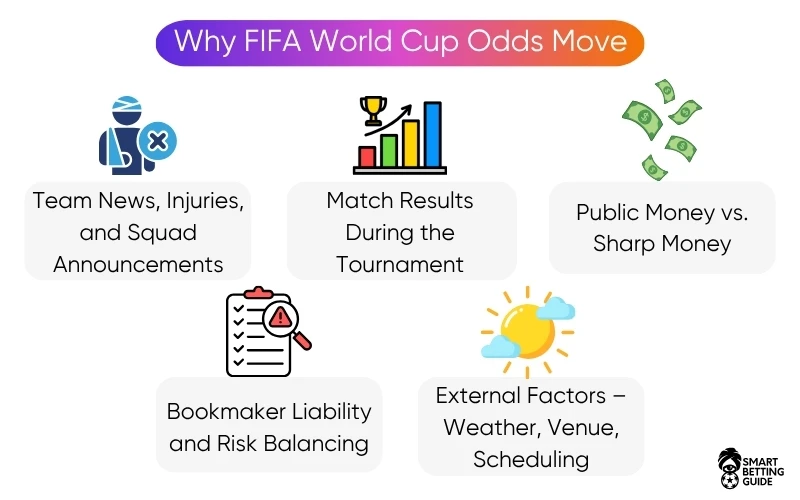
Team News, Injuries, and Squad Announcements
Nothing moves a World Cup market faster than important squad news. If a star player suffers an injury, odds can shift within minutes across the entire outright market.
One recent example came before the 2022 World Cup, when Karim Benzema withdrew from France’s squad shortly before the tournament began.
Managerial uncertainty, late fitness concerns, suspensions, and tactical changes also influence pricing. Markets react not only to the absence of elite players, but to uncertainty itself. Even unclear injury reports can trigger temporary movement before official confirmation arrives.
Match Results During the Tournament
The outright market can change fast during a World Cup. One heavy win, one upset, or even a favourable knockout path can completely reshape pricing within hours.
A dominant group-stage performance can shorten a nation’s odds significantly, while a surprise defeat can send prices drifting immediately.
Knockout brackets also matter. Sometimes a team’s odds improve not because they played brilliantly, but because another tournament favourite was eliminated from their side of the draw. This is especially visible late in tournaments, where route difficulty becomes nearly as important as team quality itself.
Readers following the broader tournament picture can also compare movement patterns alongside the 2026 FIFA World Cup Schedule to understand how rest days and knockout positioning affect markets.
Public Money vs. Sharp Money
Public money and sharp money move markets differently. During a World Cup especially, casual bettors love backing teams like Brazil, England or Argentina regardless of whether the number still offers value.
Sharp money works differently. Sharp bettors usually care more about the number itself than the storyline around a team. Sometimes the public heavily backs one side, yet the line moves the opposite direction because respected bettors are taking the other side at larger stakes.
If England keeps taking public money but the line moves toward the opponent anyway, that’s classic reverse line movement. And that’s why not every odds move should be treated the same way.
Bookmaker Liability and Risk Balancing
World Cup bookmakers do not move odds purely because they believe one outcome is more likely. They also move prices to manage risk exposure. If too much money enters one side of a market, bookmakers may shorten that outcome simply to reduce further liability and encourage action elsewhere.
This becomes especially important during global tournaments where emotional betting volume increases dramatically. A drifting favourite does not always mean confidence is falling internally. Sometimes it simply means the bookmaker already holds too much exposure on the opposite side of the market.
External Factors – Weather, Venue, Scheduling, Refereeing
External tournament conditions matter more than many casual bettors realise. The 2026 World Cup will be hosted across the United States, Canada, and Mexico, creating major differences in altitude, climate, travel distance, and recovery time between fixtures.
Teams facing quick travel turnarounds across long distances may see market reactions once scheduling becomes clearer.
Heat, humidity, and referee assignments can also influence late movement, particularly in individual match markets close to kickoff. Official venue and tournament information can always be verified through FIFA.com.
How to Read FIFA World Cup Odds Movement Step by Step
One of the biggest mistakes newer bettors make is overreacting to every line move as if the market suddenly knows the final result.
One way to read movement more clearly is by following a simple four-step approach.
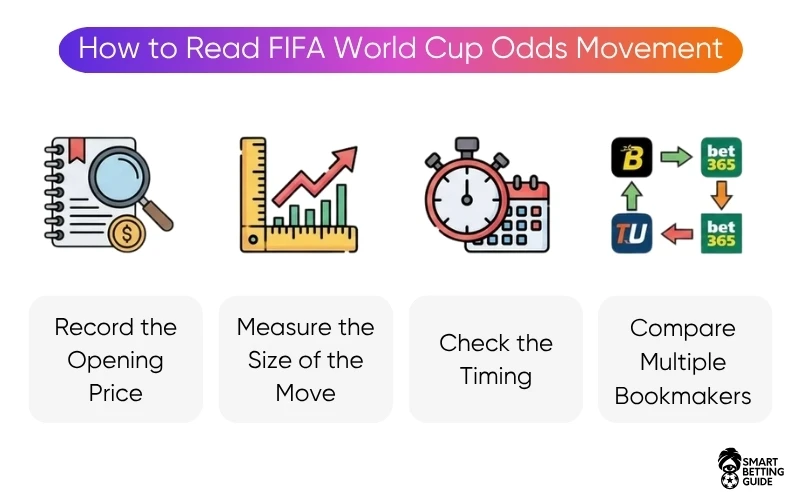
Record the Opening Price
The opening line gives you a baseline. Without knowing where the market started, it becomes difficult to judge whether current prices represent meaningful movement or normal fluctuation.
Many bettors make the mistake of looking only at the latest odds without understanding how the market arrived there. Opening numbers matter because they often contain the bookmaker’s cleanest early assessment before public betting volume distorts pricing.
Measure the Size of the Move
Not every shift matters equally. A move from 6.00 to 5.80 is very different from a move from 6.00 to 4.50. Serious bettors often translate decimal odds into implied probability instead of focusing purely on the decimal itself.
For example:
6.00 implies roughly 16.7%
5.00 implies 20%
That may not sound dramatic at first glance, but it represents a meaningful market adjustment.
Suppose France opened at 6.00 in the outright market before the tournament. After a dominant 3-0 group-stage victory, the market shortens them to 5.00. The shift tells us the market now rates France more highly than before – but it does not guarantee they will win the tournament.
The key lesson is understanding probability adjustment, not chasing momentum blindly.
Check the Timing
Timing often explains the movement itself. Did the line move immediately after confirmed team news? Did it happen after a key injury update? Did it follow a major upset elsewhere in the bracket?
If there’s no obvious injury news or result behind the move, it often means respected money hit the market before the wider public reacted.
That’s why a lot of bettors keep a close eye on the market around:
- squad announcements
- final training reports
- and pre-match press conferences
Compare Multiple Bookmakers
One bookmaker moving alone does not necessarily mean the entire market agrees. Sometimes a single sportsbook adjusts aggressively because of its own exposure. Other times, nearly every bookmaker moves simultaneously, signalling a broader market consensus.
This is why odds comparison pages are useful during major tournaments. Comparing movement across books helps separate isolated liability adjustments from genuine market-wide reactions.
Tracking Odds Movement Tools and Sources
Most bettors track odds movement using a mix of comparison sites, bookmaker apps, and market discussion online. If you’re only watching one sportsbook, you’re often missing the bigger picture.
Odds comparison platforms remain one of the easiest ways to see how prices are moving across multiple sportsbooks at the same time. They help you spot whether a move is isolated to one bookmaker or happening across the wider market.
For deeper analysis, line history trackers can be even more useful. Instead of showing only the current price, they allow you to see how the market got there. That often makes it easier to understand whether odds reacted to an injury update, a major result, or sharp betting activity.
Some bookmaker apps also highlight movement internally through “was/now” indicators, live price changes, or temporary boosts around major matches.
During tournaments like the World Cup, many bettors also keep an eye on:
- Betting communities
- Social media
- Market discussion online
News, injury rumours, and market chatter often start circulating there long before casual bettors notice the market changing.
That said, you should be careful not to treat every rumour as fact. Publicly visible movement data usually lags behind the fastest sharp action by several minutes or longer, and that delay becomes especially noticeable around injuries or late squad news.
If you’re newer to football betting, the 1×2 Football Betting Guide for FIFA World Cup can also help you understand the fundamentals before diving deeper into odds movement analysis.
Reading the 2026 FIFA World Cup Market: What to Watch
The 2026 tournament introduces several structural changes that will influence betting markets differently from previous World Cups. The expanded 48-team format increases overall market complexity. More nations in the field means more longshots, more pricing uncertainty, and potentially more inefficiencies early in the outright market.
That does not automatically create value, but it does widen the range of possible market reactions compared to older 32-team tournaments.
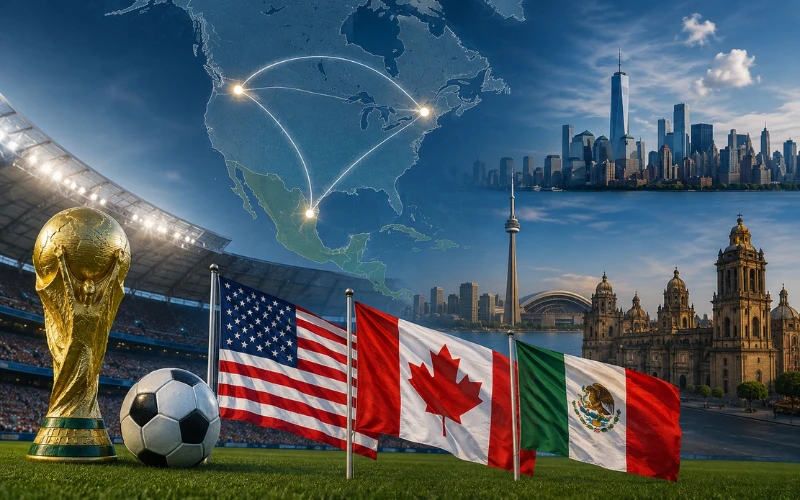
The three-host setup across the United States, Canada, and Mexico also creates logistical variables the market will monitor closely. Travel distance, climate variation, altitude, and recovery time could all become important pricing factors during the group stage and knockout rounds.
Movement is likely to become most aggressive during four specific tournament windows:
- final squad announcements
- the opening matchday
- the final round of group-stage fixtures
- and the quarter-finals
Historically, outright winner odds, Golden Boot markets, match 1X2 lines close to kickoff, and “to reach the final” markets tend to attract the sharpest movement.
Common Mistakes When Reading Odds Movement
Even experienced bettors can misread odds movement when they focus on the price itself without considering the context behind it. During major tournaments, the same mistakes tend to appear again and again.
Here are some of the most common ones:
- Treating every shortening price as a betting signal. A shorter price simply means the market adjusted – it does not automatically mean the bet is suddenly good value.
- Ignoring the opening line. Without the opening number, it is difficult to judge whether movement is meaningful or minor.
- Confusing public money with sharp money. Popular teams often shorten because of recreational action rather than respected betting activity.
- Chasing steam too late. By the time most bettors react to a steam move, the best number is often already gone.
- Assuming one bookmaker represents the entire market. Single-book movement may reflect internal exposure rather than true consensus.
- Reading movement without context. Odds shifts without injury news, tactical changes, or meaningful results sometimes carry little informational value at all.
Odds Movement vs. Value Betting & Where They Meet
Odds movement and value betting are closely connected, but they’re not exactly the same thing.
| Odds Movement | Value Betting |
|---|---|
| Tracks how betting odds change over time. | Focuses on finding odds that are higher than the true probability of an outcome. |
| Can highlight market corrections and shifts in sentiment. | Aims to identify mispriced markets before they correct. |
| Helps bettors spot potential value opportunities. | Uses those opportunities to place +EV bets. |
| Example: Odds drop from 7.00 to 5.50. | Taking 7.00 before the drop may indicate value. |
| Not a betting strategy on its own. | Requires accurate probability assessment. |
| Where They Meet: Consistently securing better odds than the closing line (beating the market) is often considered evidence of successful value betting. | |
FIFA World Cup Responsible Gambling
World Cup betting should remain entertainment, not financial pressure. Even experienced bettors misread markets, and no odds movement guarantees a result.
Only bet amounts you can comfortably afford to lose, consider using deposit limits where available, and take breaks if betting stops feeling enjoyable.
Support and responsible gambling tools are available through BeGambleAware and GamCare.
FAQ About FIFA World Cup Odds Movement
⭐ What does it mean when World Cup odds shorten?
When odds shorten, the implied probability of that outcome increases in the eyes of the market. This can happen because of betting activity, team news, injuries, or bookmaker risk adjustments.
⭐ What is a “steam move” in World Cup betting?
A steam move is a fast and aggressive market move where odds shift across multiple bookmakers almost simultaneously, usually after sharp action or major news breaks.
⭐ How often do FIFA World Cup odds change?
Sometimes odds barely move for hours. Other times, one injury update or surprise result can reshape the market almost instantly.
⭐ Can I tell who will win from odds movement?
No. Odds movement reflects market opinion and bookmaker adjustments, not certainty. Movement can provide useful signals, but it does not predict outcomes with certainty.
⭐ Where can I see historical World Cup odds movement?
Odds comparison websites and line history trackers usually provide historical market data showing how prices changed over time.
⭐ Do World Cup odds move more during the tournament or before it?
Both periods can produce major movement, but the sharpest reactions often happen during the tournament itself because matches immediately reshape outright markets and knockout paths.
⭐ What is the difference between public money and sharp money?
Public money usually comes from recreational bettors backing popular teams, while sharp money refers to larger or more informed wagers placed by experienced bettors and professional syndicates.

Crypto and Sports Betting Expert