Card Betting at the FIFA World Cup 2026
-
 Dalius Mikalauskas
 -
29 May 20269 min. read

Every football fan is getting ready for summer as the FIFA World Cup brings 104 matches to enjoy. To make the tournament even better, why not give card betting a try? We explain everything you need to know in this guide, so feel free to grab a notepad — or just keep the best tips in mind.
Table of content
Key Takeaways
- Underdogs use physical play and get booked more.
- Markets usually include only 90 minutes and injury periods.
- Card betting means predicting how many cards will appear in a match.
- Referee style matters. Always check stats before betting on cards in football.
- Group stage games bring fewer cards, while knockout games increase the number.
What Is Card Betting in Football?
Betting on cards in football is all about focusing on the “discipline” of a match. In other words, you’re guessing how many cards the referee will show during the game. Now, let’s look at how these bets show up on your slip.
How Card Bets Work
Football cards betting means predicting how many yellow or red cards will be shown during a match. You can choose from markets like total cards, cards for specific players, or even special point-based systems.
Just remember, only cards from the first 90 minutes and stoppage time are included. Anything that happens in extra time or penalties won’t affect your bet.
Football Cards Betting Markets Explained
There are many ways to take part in football betting cards, from simple total bets to detailed player predictions.
To make things easier to follow, the table below shows the most popular options for the 2026 World Cup.
| Market | What You Are Betting On |
|---|---|
| Total cards Over/Under | Whether the combined number of cards stays below or goes above a set number. |
| Booking points Over/Under | Betting on the total points assigned to cards based on a specific scoring system. |
| Player to be booked | Picking a specific individual to receive a card at any time during the match. |
| First to be booked | Selecting which player will be the very first to see a card from the referee. |
| Time of first booking | Predicting whether the first card happens before or after a certain minute mark. |
| Team cards Over/Under | Focusing only on how many cards a specific country receives during the game. |
| Card handicap | Giving one team a “head start” or “deficit” in card totals to level the odds. |
| Red card Yes/No | A simple bet on whether any player will be sent off during the 90 minutes. |
| Cards per half | Splitting your prediction between the first 45 minutes and the second half. |
How Booking Points Work
Booking points are an easy way to follow discipline by giving different values to each card. The system is useful because serious fouls matter more, which means a red card adds far more points than a yellow.
It allows licensed betting operators to set fairer lines and gives you more control over your betting decisions.
For example, imagine betting on “Over 45.5 points” in a tough knockout game. If the match ends with five yellow cards (5 x 10 = 50 points) and one red card (25 points), the total comes to 75 points, making your bet a winner.
Check the table below to see how these points are normally counted:
| Card Type | Points |
|---|---|
| Yellow card | 10 |
| Straight red card | 25 |
| Two yellows followed by red (same individual) | 35 (maximum per person) |
How Is Card Betting Different at the World Cup?
Bet on cards changes a lot during the FIFA World Cup. With different rules and football players from various countries, clear patterns start to appear that you can use to your advantage. Take a look at them.
Referees From Six Confederations — Each With Different Styles
At the World Cup, referees come from different countries, and they don’t all manage games the same way. A referee from Europe might allow more physical play, while one from South America could give cards more quickly.
Since referees are announced just days before the match, you get a great chance to check their past stats on sites like TransferMarkt.
The Fair Play Tiebreaker Suppresses Group-Stage Cards
At the start of the group stage, teams try their best to play fair and follow the rules. This is because “fair play” is often the secret way to break a tie.
If two teams have the same score and goals at the end, the team with the fewest yellow and red cards moves forward. This rule keeps matches calmer, especially in the early weeks. For bettors, that often means “under” bets can pay off in these quieter fixtures.
Knockout Rounds Produce More Cards
Once the tournament reaches the “win or go home” stage, everything changes. Teams stop holding back, and fair play is no longer the main focus. Football players fight for every moment, and fouls or hard challenges become part of the game.
Looking at past games, these knockout rounds are known for being card-heavy. As pressure rises, betting on a higher number of bookings starts to make much more sense.
Quality Gaps and Tactical Fouling
When a smaller team faces big competitors like Brazil or France squad, they often rely on physical strength to compete. Since the stronger team is usually faster and more skilled, the underdog may take a few yellow cards to slow the game and stay in it.
In these mismatched games, paying attention to how many cards the defending team receives can be a very smart move. It shows how smaller teams use effort and tough play to challenge the top sides.
Suspension Rules Create Late-Group Dynamics
Football players at the World Cup need to stay careful, as just two yellow cards in different matches lead to a one-game suspension. Towards the end of the group stage, many top players opt for safer tactics to avoid suspension.
At the same time, teams that have already qualified might rotate their team and use backups, who don’t always have the same discipline. This can change how cards are given, which can be useful if you’re closely watching team lineups.
Betting on Cards in Football Strategies for World Cup 2026
To do well in football cards betting, you need a combination of data and an understanding of the game’s flow. Use these tips to guide your predictions and spot the best value across all 104 matches.
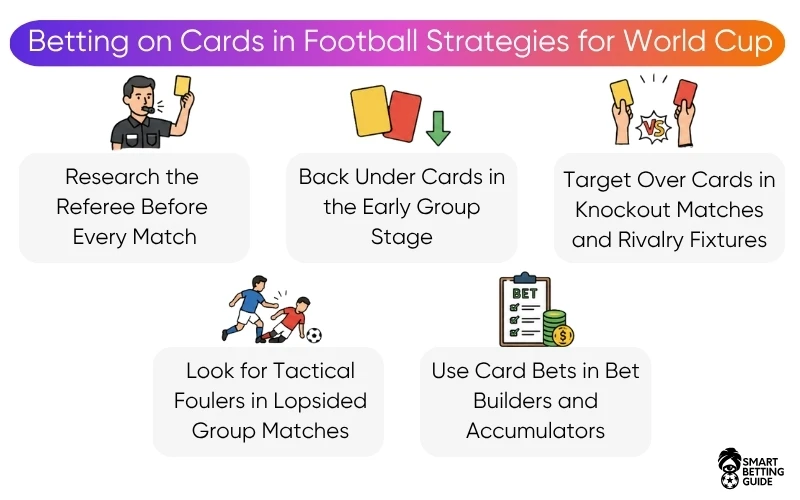
Research the Referee Before Every Match
Since many World Cup referees may not be well-known to casual fans, checking their stats is one of the most important steps. Look at their home confederation and recent international matches to understand if they are strict or more relaxed with their decisions.
A referee who often hands out five or more yellow cards can quickly influence your betting outcome.
Back Under Cards in the Early Group Stage
The fair play rule encourages teams to play carefully, so the first rounds are usually calmer. Teams often focus on keeping a clean record rather than risking their chances with too many cards. That’s why going for “Under 3.5 total cards” can be a good option in early fixtures.
Target Over Cards in Knockout Matches and Rivalry Fixtures
Games become more intense when rivals meet or when losing means elimination. Old rivalries and knockout pressure often bring more fouls and emotional reactions.
If a strict referee is handling a heated match, betting on “Over” for cards or booking points is a great option.
Look for Tactical Foulers in Lopsided Group Matches
When one side dominates possession, defenders are more likely to give away fouls under pressure. Focus on defensive midfielders and full-backs who have to deal with skilled wingers. Finding these “enforcers” can open up good opportunities in the “player to be booked” market.
Use Card Bets in Bet Builders and Accumulators
Card markets are a great way to increase the odds of your same-game parlays. You can easily combine a card pick with outcomes like “both teams to score” to make things more interesting.
In tight matches, both goals and fouls are common, so these markets go well together.
World Cup 2026 — Fixtures With High Card Potential
Some FIFA matches are naturally more intense than others, making them great for discipline-based bets. Big pressure, long-standing rivalries, and clashing styles can quickly turn a game into one where the referee needs to step in more often.
Here are some key matchups and situations where things are more likely to get heated:
| Fixture / Group | Why Cards Could Be High |
|---|---|
| Argentina group matches (Group J) | Historically, one of the most-booked nations with a joint record of 11 all-time red cards. |
| USA vs Türkiye (Group D) | High-intensity atmosphere with a passionate home crowd often leads to emotional fouls. |
| England vs Croatia (Group L) | A deep, recent history (the 2018 World Cup semi-final) and competitive rivalry ensure that every challenge is contested fiercely. |
| France vs Norway (Group I) | Two physical European powerhouses that use tactical fouls to stop elite attackers. |
| Brazil vs Morocco (Group C) | Morocco’s disciplined defensive block against Brazil’s flair often results in tactical bookings. |
| Any “Winner-Takes-All” Group Match | Desperation in the final group games drives aggressive play as teams fight to stay in the tournament. |
| Round of 16 and Quarter-finals | These elimination rounds are statistically the peak of card activity in World Cup history. |
| Local Derbies (e.g., USA vs Mexico) | Geographic proximity and long-standing grudges almost always guarantee a high card count. |
| Technically Lopsided Games | Underdogs often resort to persistent fouling to disrupt the rhythm of world-class opponents. |
Common Card Betting Mistakes at the World Cup
Even skilled bettors can slip up when moving from domestic leagues to international football cards betting. The World Cup has its own pace and rules, so it’s easy to fall into traps that can quickly lead to poor decisions.
To help you stay prepared and right on track, here are some common pitfalls to avoid:
- Forgetting extra time and penalty cards doesn’t count.
- Not considering whether it’s a high or low-pressure match.
- Betting over cards early without considering fair play rules.
- Not checking the referee and their stats before placing bets.
- Using league card stats without adjusting for the World Cup.
- Overlooking suspensions and less disciplined replacements.
Final Thoughts on Card Betting
Card betting at the World Cup suits those who take their time and do their research. The 2026 tournament brings a special mix of refereeing styles from around the world, strict fair-play rules, and the intense emotions of knockout matches.
With 104 games, you have more chances than ever to spot value by looking beyond goals and focusing on discipline through football cards betting.
To get started, look at the referee’s past games and think about how important the match is for both sides. A slow group stage match and a high-pressure knockout game can play out very differently, which is key when you bet on cards.
If you stay focused and follow the patterns, football betting cards markets can become a strong and reliable option.
FAQ About FIFA World Cup Card Betting
⭐ What is card betting in football?
Card betting in football is a popular market where you predict how many cards the referee will show, including yellow and red cards. Instead of focusing on goals, you focus on discipline and how players behave.
⭐ How do booking points work?
Booking points function by assigning a numerical value to each card: 10 points for a yellow and 25 points for a straight red. If a player receives two yellows followed by a red, they earn a maximum of 35 points for your bet.
⭐ Do extra time cards count in card betting?
Extra time cards typically do not count toward standard card betting markets, as most bets are settled based on the””Regular Time” result (90 minutes plus injury time).
⭐ How many cards are there on average at a World Cup match?
At the World Cup, matches usually average between 3.5 and 4.5 cards. In 2022, there were about 3.4 yellow cards per game, though this number often increases once the knockout stage begins.
⭐ Which teams get the most cards at FIFA World Cups?
Teams with the most cards include Argentina and Brazil, who share the record for the most red cards in tournament history. Argentina also holds the record for the most total yellow cards.
⭐ Can you bet on a specific individual to be booked?
You can find player booking bets on most betting sites, where you simply pick a player you expect to receive a card. The “Player to be Booked” market is very popular when a defender is up against a strong attacking player.
⭐ Is card betting profitable at the World Cup?
Card betting profitability at the World Cup is possible for bettors who research referee tendencies and match context. By identifying strict officials and high-pressure rivalry games, you can find better value.

Crypto and Sports Betting Expert