Beach vs. Indoor Volleyball: Key Differences Explained
-
 Written by
Dalius Mikalauskas
Written by
Dalius Mikalauskas -
30 Jan 20267 min. read

One might think all volleyball games are pretty much the same, but all types, including indoor and beach volleyball, have quite a few things of their own.
Each format has its unique game, from team sizes and playing surfaces to scoring rules. Whether you’re a player, fan, or bettor, understanding these differences helps you appreciate what makes each volleyball type special.
In our guide, we break down everything you need to know about beach vs. indoor volleyball.
Table of content
- Key Takeaways
- Overview of Volleyball
- Volleyball Team Size & Court Setup
- Equipment Variations in Beach vs. Indoor Volleyball
- Volleyball Scoring Systems & Match Structure
- Rules & Player Roles in Different Volleyball Formats
- Playing Conditions in Volleyball
- Play Style & Physical Demands
- Indoor Volleyball vs Beach Volleyball in Betting
- Conclusions on Beach vs. Indoor Volleyball
Key Takeaways
- Indoor volleyball uses six specialized players per position; beach volleyball requires two players to master all skills.
- Wind shifts the ball 2-3 feet, sand slows movement, and temperature extremes affect play—unlike indoor’s controlled conditions.
- Indoor: best-of-5 sets to 25 points, 18m × 9m court. Beach: best-of-3 sets to 21 points, 16m × 8m court.
- Beach blocks count as first touch, and no finger tipping allowed; indoor blocks don’t count, and finger redirects are legal.
- Indoor features quick jumps and direction changes on hard courts; beach requires more endurance while fighting sand resistance.
- Beach volleyball betting is less predictable due to weather, partner changes, and no substitutes; indoor offers more stable odds.
Overview of Volleyball
The sport of volleyball started in 1895 when William Morgan created it in Massachusetts. He wanted a game that mixed basketball, baseball, tennis, and handball. Indoor volleyball came first and spread through schools and clubs. Beach volleyball developed later in the 1920s on California beaches.
Volleyball comes in 2 main forms that people play worldwide. Indoor volleyball happens in gyms and sports halls, while beach volleyball takes place on sand courts.
Both versions share the same basic goal – to hit the ball over the net and make it land in the other team’s court.
| Type | Where It’s Played | Popularity/Status |
| Indoor | Gyms, sports halls | Most played worldwide |
| Beach | Sand courts | Olympic sport since 1996 |
| Grass | Parks, backyards | Casual recreation |
| Snow | Winter resorts | Growing winter sport |
| Sitting | Indoor courts | Paralympic sport |
| Water | Pools | Summer recreation |
| Footvolley | Sand courts | Popular in Brazil |
| Wallyball | Racquetball courts | Uses wall rebounds |
Volleyball Team Size & Court Setup
Indoor volleyball teams play with 6 players each, and you can have substitutes, too. The number of substitutes depends on the level of play and the number of leagues.
For example, in FIVB (International Volleyball Federation), 6 substitutes are allowed, domestic rules approve 12 substitutes, while high-school and college tournaments permit 15 substitutes. The game uses standard hard courts that measure 18 meters by 9 meters.
Beach volleyball works differently. Teams have only 2 players, and no substitutes are allowed. The sandy court is smaller at 16 meters by 8 meters. The net is also thicker and more resistant to the weather.
| Feature | Indoor Volleyball | Beach Volleyball |
|---|---|---|
| Team Size | 6 players | 2 players |
| Substitutes | Yes | No |
| Court Size | 18m × 9m | 16m × 8m |
| Surface | Hard court | Sand |
| Net Type | Standard | Thicker, weather-resistant |
Equipment Variations in Beach vs. Indoor Volleyball
Indoor volleyballs are heavier and firmer, which makes them faster to play with. The official ball, approved by the FIVB, is MIKASA V200W, weighing 260-280g at 65-67cm.
Beach volleyballs are slightly larger and softer. Currently, the official ball used for the World Beach Tour and the Olympics is the BVC550C, also weighing 260-280g, but reaching 66-68 cm in size. They have lower pressure inside, which helps control the ball and adapt to wind conditions.
Additionally, beach volleyball nets have thicker tops. This helps them stay strong outdoors and handle weather changes better. Although the heights are the same for both, the only difference is between the women’s and men’s volleyball. The height for men is 2.43 meters, while for women it’s 2.24 meters.
Volleyball Scoring Systems & Match Structure
Indoor volleyball usually uses best-of-5 sets, meaning you have to win 3 sets in total. However, smaller tournaments typically use the best-of-3, meaning the victory is yours after winning 2 sets. Lesser-known competitions use it to save time if there are a lot of registered teams.
As for the indoor volleyball scoring system, you need 25 points to win each set, but you must win by at least 2 points. If the match goes to a fifth set, teams play to only 15 points and switch sides after 7 points.
Beach volleyball keeps things shorter with best-of-3 sets. The first 2 sets go to 21 points. If teams need a third set to break a tie, they also play to 15 points. Teams must switch sides every 7 points to keep conditions fair for both sides, as the sun and the wind can impact the play.
| Indoor Volleyball | 5 sets maximum | 25 points per set (15 for the fifth set) |
| Beach Volleyball | 3 sets maximum | 21 points per set (15 for the third set) |
Rules & Player Roles in Different Volleyball Formats
Even though indoor volleyball and beach volleyball have the same word in them, the games’ rules differ quite a bit.
Touch Rules
Touch rules change between indoor and beach volleyball. Beach volleyball blocks count as your first touch, and you get only 2 more touches after a block. Meanwhile, blocks don’t count as a touch in indoor volleyball, so teams still get three full touches after blocking.
In both volleyball formats, no double-contact is allowed, but in beach volleyball, tipping is also forbidden. In indoor volleyball, players can redirect the ball with their fingers as long as it’s not a double hit.
Player Roles
The 2 players on the beach volleyball court do everything – block, set, pass, and attack during the game.
Meanwhile, indoor volleyball players specialize in different positions.
| Indoor Volleyball Positions | |
| Middle Blocker | Blocks and attacks quick balls near the center. |
| Libero | Plays back row defense and receives serves; can’t attack or serve. |
| Outside Hitter | Attacks from the left side and receives serves. |
| Opposite Hitter | Hits from the right side and blocks the opponent’s outside hitter. |
| Setter | Sets up the ball for attackers to hit. |
| Defensive Specialist | Like a libero, but can serve and play front row briefly. |
Playing Conditions in Volleyball
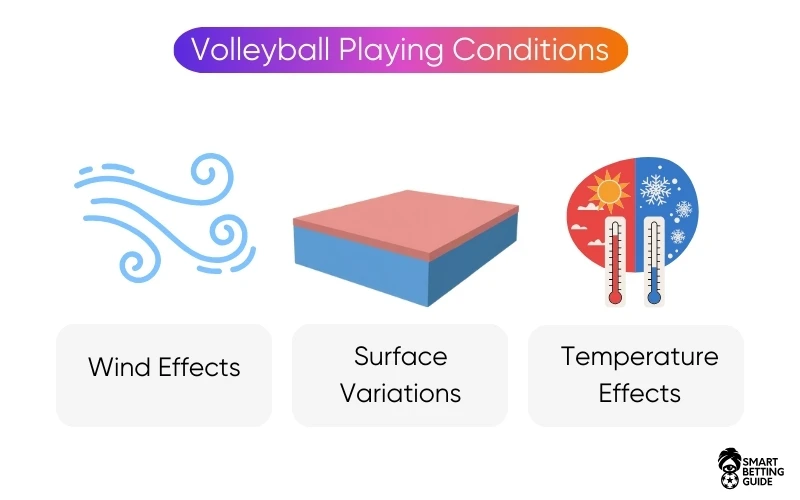
The environmental challenges of beach volleyball, like unpredictable winds and sand temperature, create completely different experiences from indoor volleyball, where conditions never change.
Wind Influence
Weather changes everything in beach volleyball. Wind speeds above 15 mph can push the ball off course by 2-3 feet during serves. Players must adjust their hitting angle and power based on wind direction. Strong gusts can turn a perfect set into an impossible play, and the other way around.
Surface Difference
Beach players sink 2-6 inches into the sand with each step. This makes quick direction changes nearly impossible, so they must plan their steps accordingly. Indoor players can maneuver instantly on hard courts and reach balls 10-15 feet away in under 2 seconds.
Temperature Impact
Temperature matters too. Beach sand can burn players’ feet on hot days, and it can be hard to move on cold days. Indoor courts stay at the same temperature year-round, and also their feet are protected by volleyball shoes.
Play Style & Physical Demands
Indoor volleyball has quick rallies with specialized positions. Setters run the most during matches, while middle blockers cover less ground. Players jump frequently and use explosive movements. The hard court surface allows quick direction changes and powerful attacks.
Beach volleyball demands different skills. Players cover more court space since only two people play. Everyone must pass, set, attack, and defend. The sand surface makes movement harder, and jumping takes more effort. Players use more strategic placement instead of pure power.
| Aspect | Indoor Volleyball | Beach Volleyball |
|---|---|---|
| Court coverage | Specific zones | Entire court |
| Jump effort | Many easy jumps | Fewer hard jumps |
| Playing style | Power hitting | Smart placement |
| Recovery time | Switch only between sets | Side switches every 7 points |
| Specialization | Position experts allowed | All-around skills required |
Indoor Volleyball vs Beach Volleyball in Betting
Volleyball betting markets are treated differently by sports betting sites. Indoor volleyball has more stable conditions, which makes outcomes easier to predict. This reduces random factors that affect betting odds.
Beach volleyball brings more uncertainty to betting. Weather variables like wind and sun conditions can change during matches. Additionally, beach teams switch partners more often than indoor teams.
| Main Betting Differences | |
| Partnership stability | New beach teams need time to develop chemistry. |
| Schedule density | Beach players may compete in multiple events per week. |
| Fatigue impact | Physical tiredness shows more in two-player teams. |
| Season structure | Indoor leagues run for months; beach has weekend tournaments. |
| Substitution options | Indoor teams can replace tired players mid-match. |
| Weather delays | Beach matches pause for lightning or extreme conditions. |
| Court familiarity | Indoor teams practice on their home court daily. |
Live betting works differently, too. Beach volleyball odds shift more during matches because momentum swings happen faster with only two players. One player getting tired or struggling with conditions affects half the team. Indoor teams can substitute struggling players or adjust formations using their bench.
Smart bettors consider these format differences. They track beach player partnerships and weather forecasts.
For example, they focus on team form, injury reports, and head-to-head records for indoor betting.
Conclusions on Beach vs. Indoor Volleyball
The main difference between beach volleyball vs indoor volleyball isn’t just team size – it’s how players train. Indoor players get really good at one job, while beach players must do everything well.
Weather and playing surfaces create different games. Indoor volleyball is fast and powerful because nothing changes, while outdoor volleyball is slower and uses smarter tactics because wind and sand make things more complicated. Beach vs. indoor volleyball attracts different athletes, like Kerri Walsh Jennings, who excels in outdoor conditions.
Both types help volleyball grow, have their own fans, and benefits. Together, they make volleyball popular around the world.
FAQ About Indoor & Beach Volleyball
⭐ What is the difference between a beach volleyball ball vs. indoor ball?
Beach volleyballs are slightly larger (66-68 cm) and softer with lower pressure inside, while indoor balls are smaller (65-67 cm) and firmer for faster play.
⭐ How do the rules differ in beach volleyball (blocks counting as a touch and no tipping)?
In beach volleyball, a block counts as the first touch, so you only have two more contacts afterward. Also, finger tipping is not allowed, unlike indoor volleyball.
⭐ What are the beach volleyball court dimensions vs. indoor volleyball court dimensions?
Beach volleyball courts measure 16m × 8m, while indoor courts are slightly larger at 18m × 9m.
⭐ What is the difference between volleyball and beach volleyball?
The main differences are team size (6 vs 2 players), court surface (hard vs sand), and rules like beach blocks counting as first touch.
⭐ Is the beach volleyball net lower than the indoor one?
❌ No, both use the same net heights – 2.43 meters for men and 2.24 meters for women.
⭐ How does scoring differ in beach vs. indoor volleyball?
Indoor volleyball is usually best-of-5 sets to 25 points (the 5th set to 15). Beach volleyball is best-of-3 sets to 21 points (the 3rd set to 15), with side switches every 7 points.
⭐ Do beach volleyball teams have substitutes like indoor teams?
❌ No. Beach volleyball teams have only two players and no substitutions, while indoor volleyball allows substitutes depending on the competition rules.

Crypto and Sports Betting Expert